Naradagamana Parva is the ninety-fifth Upa Parva included in the fifteenth Maha Parva, named as Ashramavasika Parva. Vaishampayana continued narration to Janamejaya in reply to his queries as follows.
When did Narada Maharshi finally visit Yudhishtira?
After two years had passed, Dritarashtra, Gandhari, Sanjaya and Kunti had gone for their old-age Vanavasa and penance, then Narada had visited Yudhishtira. It was the final visit of Narada Maharshi to Yudhishtira. Yudhishtira had enquired about the status of his mother Kunti, Gandhari and Dritarashtra, living in the forests.
What did Narada Maharshi tell Yudhishtira?
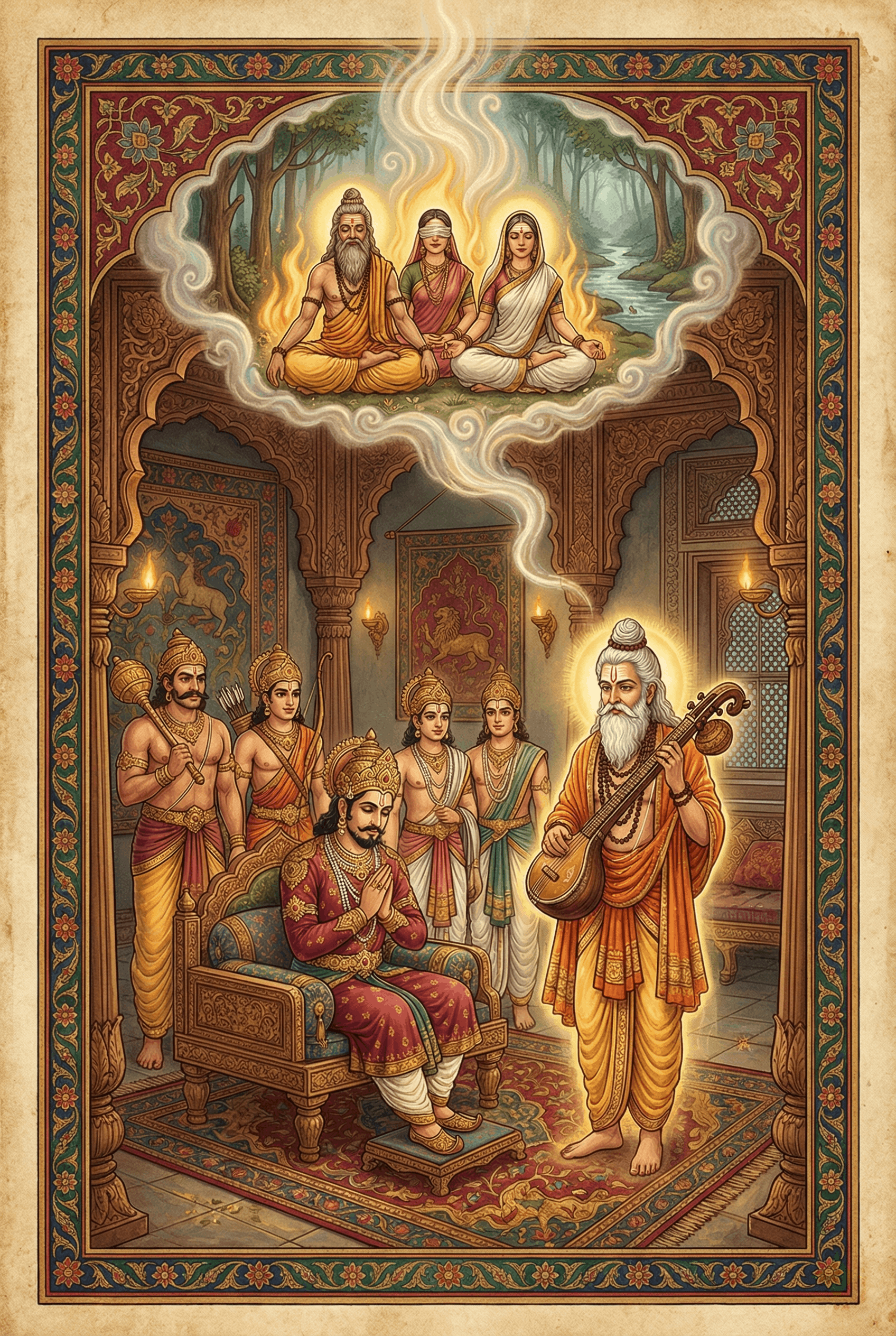
Narada Maharshi had told Yudhishtira about a forest fire and the final passage of Kunti, Gandhari and Dritarashtra to heaven. Yudhishtira was consoled by Narada, and the news was shared with the other Pandava brothers and their palace staff.
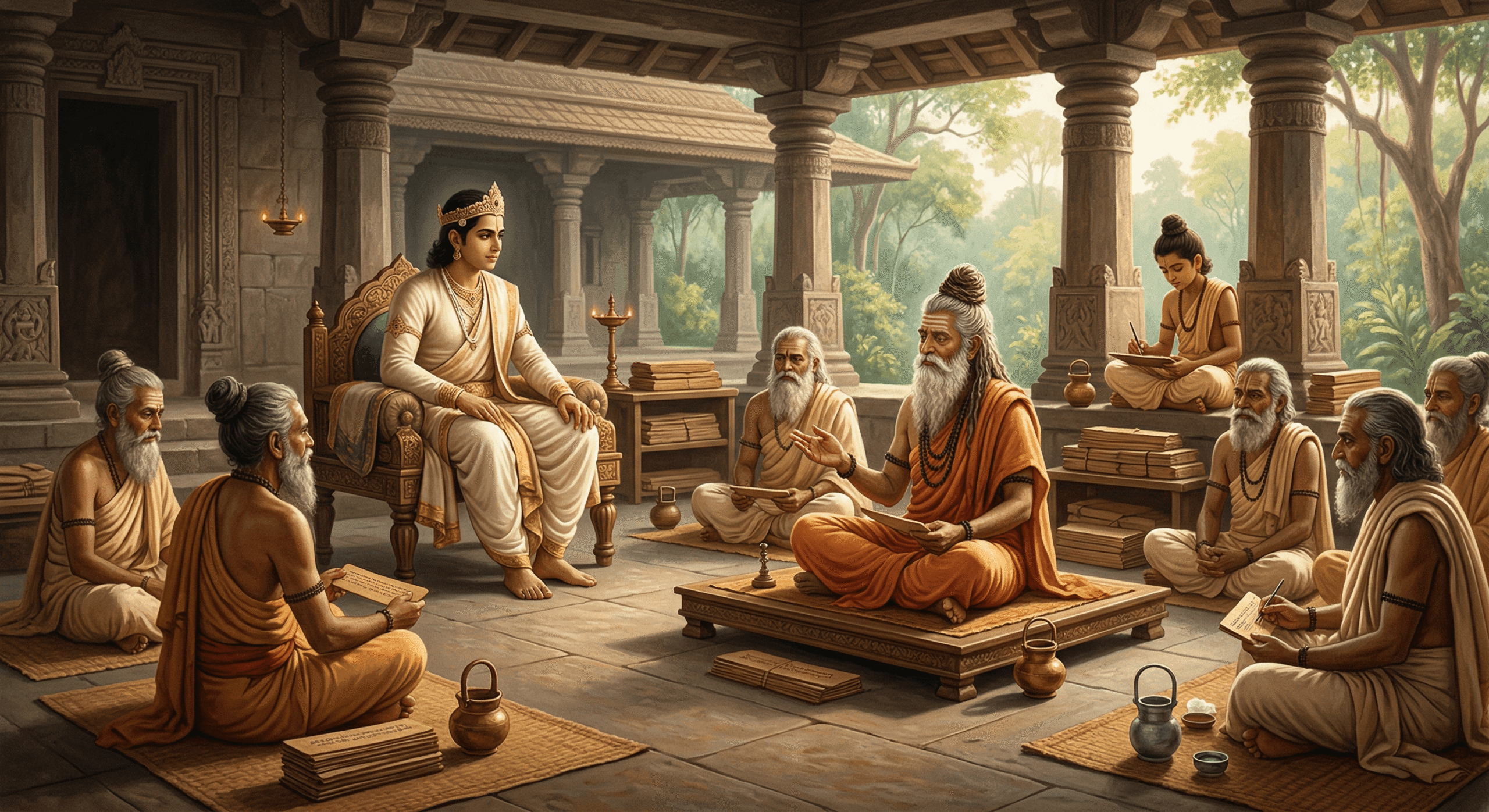
Narada Maharshi visits King Yudhishtira in Hastinapura and reveals the peaceful ascension of Dritarashtra, Gandhari, and Kunti to heaven (AI-generated image).
What did Dritarashtra request before going to heaven with Sanjaya?
Putradarshana Parva is the ninety-fourth Upa Parva included in the fifteenth Maha Parva, named as Ashramavasika Parva. Vaishampayana continued narration to Janamejaya in reply to his queries as follows.
What did Vyasa offer to Dritarashtra in the forest?
Before the start of the Mahabharata war, Vyasa had granted Sanjaya the divine capacity of vision to describe the war proceedings to the blind king Dritarashtra. In his old age, Dritarashtra started his penance in the forests, near the Ganga river bank.
One day, after the evening prayers, Vyasa appeared before Dritarashtra and told him he could offer him a boon. So Dritarashtra was free to ask for anything, and Vyasa would fulfil it.
What were the desires or sorrows of Dritarashtra, Gandhari and Kunti?
Vyasa could read the hearts of Driatarshtra, Gandhari and Kunti. Krishna had already announced the following verse in the Bhagavadgeetha before the war.
अव्यक्तादीनि भूतानि व्यक्त मध्यानि भारत । अव्यक्त निधनान्येव तत्र का परि देवना ॥
Meaning (See Bhagavadgheetha, II-28): Before the birth, the body-life was spread in different Pancha Bhuta forms. After death, the mortal body would again spread into different Pancha Bhutas forms. Between the period of birth and death, the life in the people’s body is clearly manifested, so why should one feel sorry for death? Hence, nobody should worry.
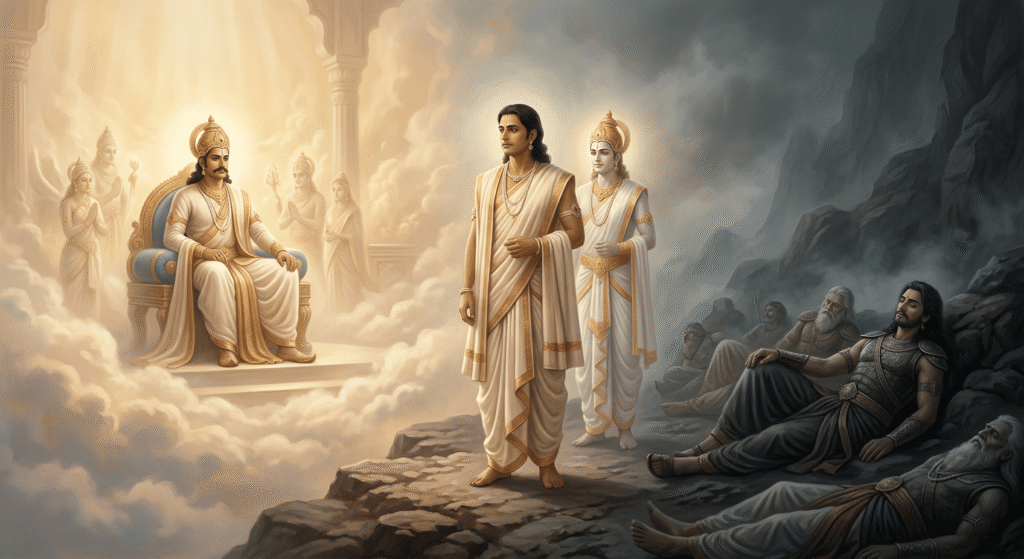
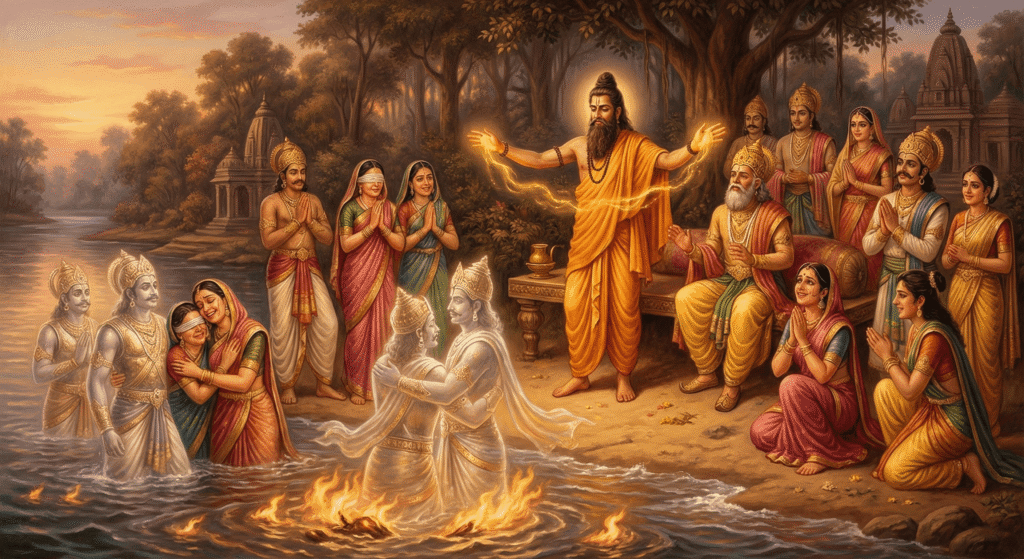
Vyasa’s miracle by the river (AI-generated image)
Vyasa tried to console the people in the forest doing penance. Vyasa wanted to prove two things. As the first one, he desired to prove that the penance was wonderfully powerful. Secondly, he could show the dead persons, just as they had been when alive, in good health, just before their death, proving the soul to be ever permanent.
This would prove indirectly that all the incarnations of Vishnu, like Rama or Krishna, always manifested in this nature. Vyasa desired to make all living people happy. They desired to see their children and brothers who had died in the Mahabharata war.
How was Dritarashtra able to see his sons at night?
Ashramavasa Parva is the ninety-third Upa Parva included in the fifteenth Maha Parva, named as Ashramavasika Parva. Vaishampayana continued narration to Janamejaya in reply to his queries as follows.
How was Yudhishtira ruling in the Hastinavati Palace with Dritarashtra?
Yudhishtira was ruling in the Hastinavati Palace with the satisfactory administration of Dritarashtra since all the other Pandava brothers were assisting him. It continued for fifteen years.
The emperor was happy since Vyasa was visiting there frequently and speaking with them all. The name and fame of the emperor Dritarashtra then spread to all the nooks and corners of the world.
न तां प्रीतिं परामाप पुत्रेभ्यः स महीपतिः । यां प्रीतिं पाण्डुपुत्रेभ्यः समवाप तदा नृपः ॥
The emperor (Dritarashtra) had received more affectionate treatment from the children of Pandu, but he had not received love from his own children before the war. Only Bhima was neutral in the proximity of Dritarashtra inside the Hastinavati Palace.
How did Yudhishtira arrange for the annual death days of all the Kauravas?
Yudhishtira was providing the required cash and stores as desired by Dritarashtra, and Yuyutsu was doing the rituals on the death anniversaries of the Kauravas. Yuyutsu was the youngest son of Dritarashtra. All the Pandavas and all the people under the administration of Yudhishtira were trying to make Dritarashtra happy. The opinions of Dritarashtra were honoured by Yudhishtira, and he was always supported.
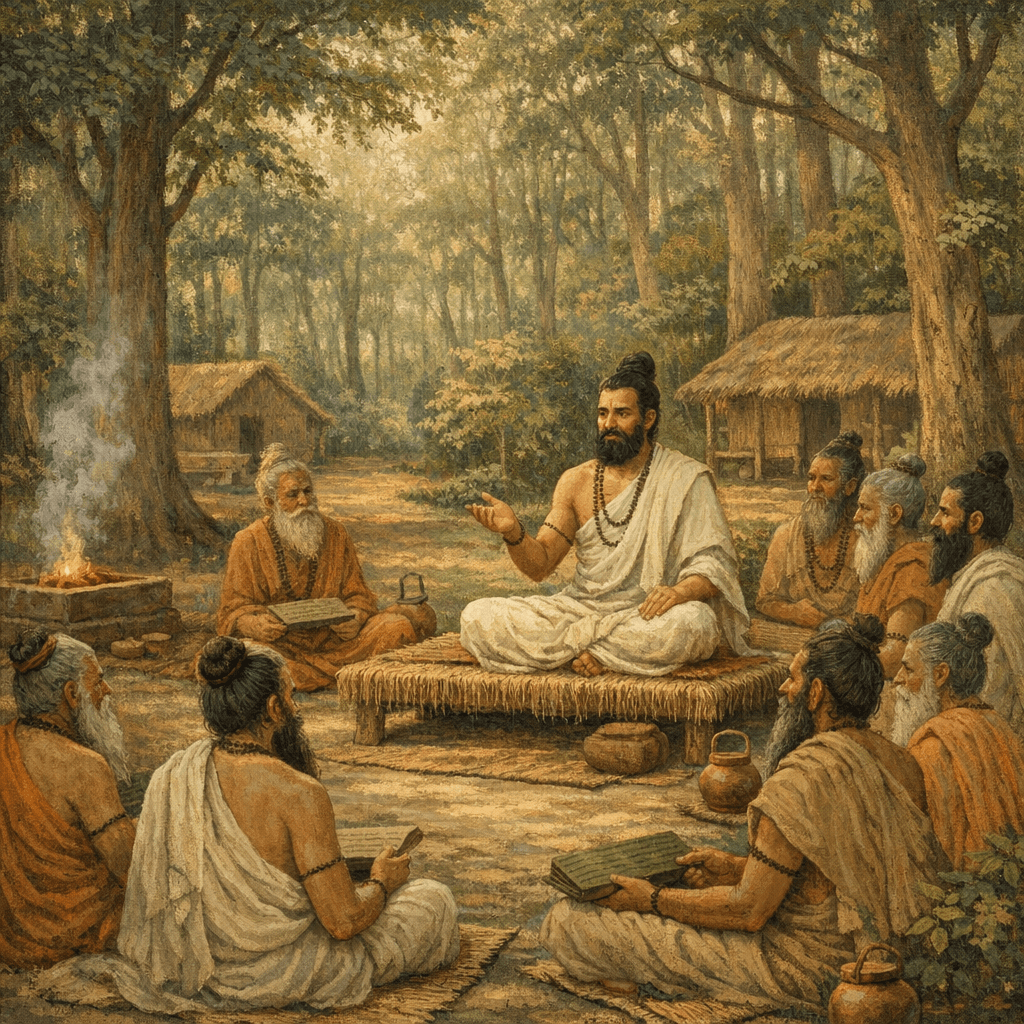
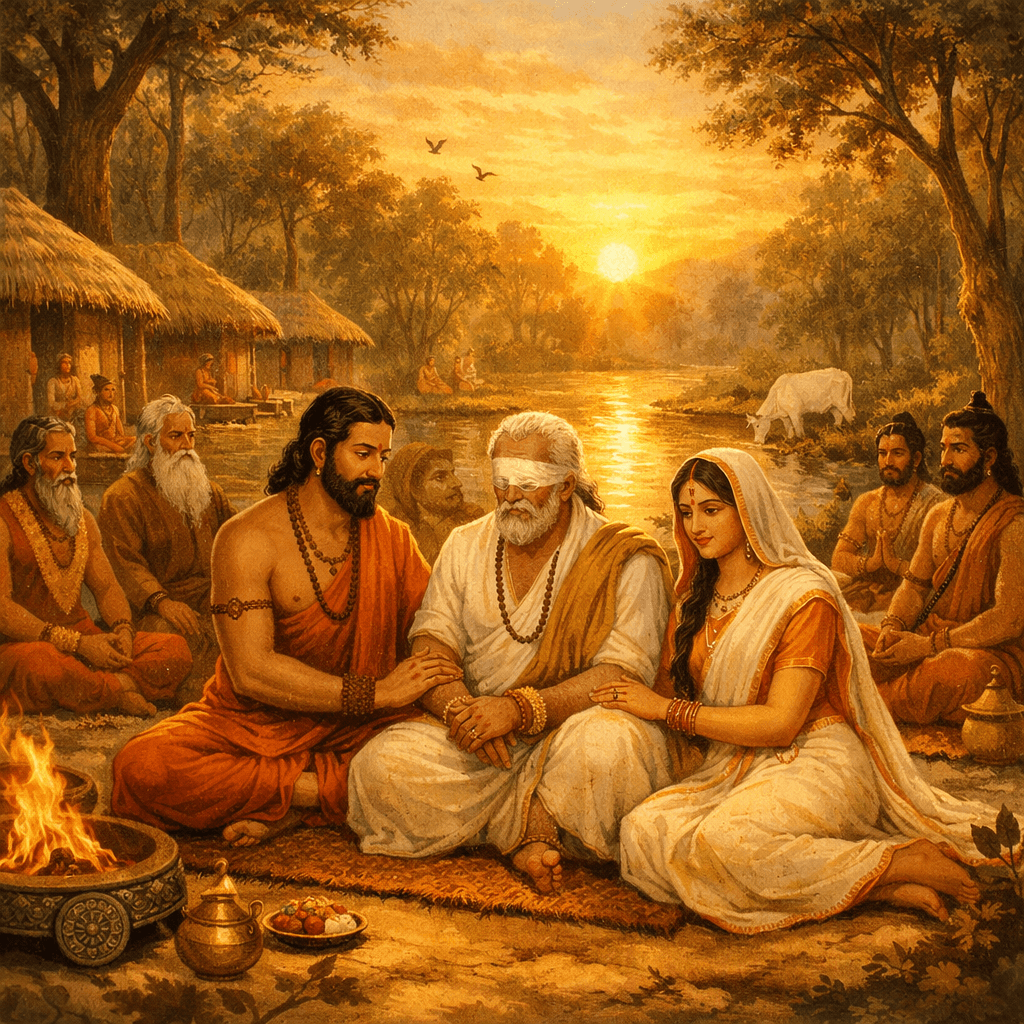
Dhritarashtra, Kunti, and Yudhishthira in a serene forest hermitage during the Ashramavasa (AI-generated image)
How did Yudhishtira arrange for the happy life of Gandhari after the war?
After the war, Yudhishtira had arranged for sufficient food, cloth and happy, healthy comforts of life for Gandhari with the help of Kunti and other Palace lady servants.
Babruvahana Parva is the ninety-second Upa Parva included in the fourteenth Maha Parva, named as Ashvamedhika Parva. Vaishampayana continued narration to Janamejaya in reply to his queries as follows.
How many Upaparvas are there in the Ashvamedhika Maha Parva?
Ashvamedhika Maha Parva contains two Upa Parvas. They are Ashvamedhika Upa Parva and Babruvahana Upa Parva. In this second Upa Parva, the yaga was completed.
How were the preliminary preparations done, and how did it succeed?
Similar to the preparations done for the past Rajasuya yaga, the Pandavas had done the preliminaries under the guidance of Vyasa. Arjuna had moved to various directions to collect movable assets, wealth and food for the yaga ceremonies.
Arjuna had not interfered in the freedom of any kingdoms but assured, under Sanatana Dharma, absolute freedom to all, with law and order. Protection was guaranteed for life on the entire earth for the righteous. The horse was followed by Arjuna with protocol, but with few soldiers. Krishna had supported the Pandavas to conduct the Ashvamedha yaga, pleasing all the angels and people.
Prince Babruvahana stands triumphant over the unconscious Arjuna, struck by the ancient Ganga curse (AI-generated image)
Why did Krishna instruct Yudhishtira to conduct the Ashvamedha yaga?
Krishna knew that some of the minor children of the deceased kings would be crowned after the Mahabharata war ended. Out of the eleven Akshohini soldiers who visited Kurukshetra, none of them were alive, but the reserve troops in the respective palaces were protecting their kingdoms, with princes being babies. It was necessary for the smooth administration of Yudhishtira to invite them all, honour them as justified by law and orders by means of an Ashvamedha yaga.
Hence, for the purpose of Ashvamedha, Arjuna was sent with the ‘free-horse’ with a small troop of soldiers for protection. All the opposing kings were brought in line under his protection, removing their hidden misunderstandings. It was a subject of Krishna for satisfying Chitrangadha and Babruvahana. They were invited to Hastinavati.
Why did Arjuna become unconscious when his son Babruvahana had fought?
Ashvamedhika Parva is the ninety-first Upa Parva included in the fourteenth Maha Parva named Ashvamedhika Parva. Vaishampayana continued the narration to Janamejaya, in reply to his queries, as follows.
What was advised by Vyasa to Yudhishtira on the banks of the River Ganga?
यजस्व वाजिमेधेन विधिवद्दक्षिणावता । बहुकामान्सवित्तेन रामो दाशरथिर्यथा ॥ यथा च भरतो राजा दौःषंतिः पृथवीपतिः । शाकुन्तलो महावीर्यस्तव पूर्वपितामहः ॥
Meaning: O Yudhishtira, please perform the Ashvamedha Yaga, observing the rules and the required donations, just as Rama, the son of Dasharatha, and Bhishma, your grandfather, had done. You may do it like Bharata, the son of Emperor Dushanta and Shakuntala, along with the donations and desired offerings. You were advised to do it similarly to your forefathers, as they were very energetic kings.
Vyasa advises Yudhishtira to perform the Ashvamedha on the sacred banks of the Ganga, with Arjuna as witness and the ceremonial horse as a peaceful symbol (AI-generated image).
Was Emperor Bharata, son of Dushanta, a relative of the Pandavas?
Yes. Shakuntala was the mother of Bharata. Bharata was installed on the imperial throne in the Hastinavati Palace at a very young age, just after crossing nine years, being the legal heir after his father, Dushanta.
Bharata had performed 1,800 (one thousand and eight hundred) Ashvamedha Yagas. “न द्वादशी समं तिथिः” meaning: in the lunar calendar, the twelfth day is called Dvadashi, and it is always the most auspicious day. Even though Bharata was a young, unmarried prince, there were procedures, as well as experts in the ritual methods, to conduct the famous Ashvamedha Yaga. He received blessings from his efficient and able mother, Shakuntala.
Hence, on every Dvadashi day, Bharata conducted the Ashvamedha Yaga; in a year, he used to do it twenty-five times. Such Yagas were continuously done by him for more than seventy-two years, totalling one thousand and eight hundred Ashvamedha Yagas. He had crossed the age of eighty-two when he had witnessed one thousand full-moon nights.
People in India celebrate when they have seen a thousand full-moon days, and it is called Sahasra Chandra Darshana Yoga. Hence, after the completion of 1,800 Ashvamedhas by Bharata, without causing any war or violence, the Rishis named this nation Bharata Varsha. Later, Emperor Bharata became Bharata Muni.
Vyasa told this old reference to uphold the importance of preserving Sanatana Dharma forever, and also to honour the late Bhishma, the son of Ganga. He was consoling Yudhishtira after the war.
Why did Vyasa suggest to Yudhishtira to perform the Ashvamedha Yaga?
Yudhishtira was feeling very sorry about the Mahabharata war, due to the heavy loss of many lives and assets during the fighting. So, he fell unconscious on the banks of the River Ganga after walking a few steps.
Bhishma Swargarohana Parva or Bhishmarohana Parva is the ninetieth Upa parva included in the thirteenth Maha parva named as Anushasana Parva. Vaishampayana continued narration to Janamejaya in reply to his queries as follows.
What was the date and time decided by Bhishma for his Swargarohana?
The date in the lunar calendar, to be prescribed then was, Uttarayana, Magha Masa, Shukla Paksha, Ashtami. Bhishma had not told the time to anybody, but decided his own time for his final journey into heaven.
That day was a pleasant one for all of the people who were silently observing the sunrise as well as the heavenly ascent of the soul of lying Bhishma, then and there.
Bhishma’s Swargarohana at sunrise on Kurukshetra (AI-generated image)
Which place did Bhishma choose for his Swargarohana?
The battlefield Kurukshetra, where he was lying after the war, Bhishma decided.
How did Yudhishtira make arrangements for the Swargarohana of Bhishma?
Danadharma Parva is the eighty-ninth upa parva included in the thirteenth maha parva named Anushasana Parva. Vaishampayana continued the narration to Janamejaya in reply to his queries as follows.
What was the story of Gautami, her son, Kaala, and Karma told by Bhishma?
Gautami was a lady sitting near a forest. Her son had died due to the bite of a serpent. Vyadha was a hunter; he searched for the serpent, tied it with a rope, and brought it in front of Gautami.
Vyadha asked Gautami how the delinquent snake should be killed. Vyadha was able to kill it by cutting it into many pieces or by cutting off its head with a sword. But Gautami was very patient and requested Vyadha to leave the serpent and let it go free. Vyadha accused the serpent very much. Gautami tried to convince him by telling him about time, the Kaala.
Then, Kaala appeared there as Kaalapurusha and explained his innocence in the killing of her son. Kaala explained that according to Karma phala, the snake had been induced to bite her son. Then, Gautami told that it was her own Karma phala (meaning the result of one’s own actions) that had put her into sorrow. So she should not kill the serpent and sin again. Non-violence was a better policy.
Later, Vyadha disappeared from there; her son got up as if from sleep, and there was no serpent also. The message was in support of life donation. Thus, Bhishma explained non-violence to Yudhishtira.
Why did Bhishma tell the above story to Yudhishtira, highlighting life donation?
Bhishma told the above story to Yudhishtira, highlighting life donation to the serpent and giving detailed explanations of Karma Siddhanta, to remove his sorrows that had arisen in his heart due to the war. Yudhishtira was frequently thinking about the war, as he was responsible for killing Karna and for Bhishma lying with wounds on the battlefield.
Bhishma imparts his final teachings on Dharma to Yudhishtira as Krishna looks on in compassionate silence at sunset (AI-generated image)
Bhishma had seized the young lady called Amba and denied her freedom of life. When Dushasana insulted Draupadi in the court session, Bhishma, due to the presence of acting emperor Duryodhana, kept silent, and so he deserved his sufferings and failures on the battlefield. Details about the past life of Karna are already available in the article Karma Siddhanta. For the resulting happiness or sorrows, one’s own past actions were the reasons. Hence, there was no need to feel sorry, and Bhishma consoled Yudhishtira.
What was the most famous recitation of Bhishma in this chapter?
Vishnu Sahasranama, or the thousand names of Vishnu in Sanskrit verses, was the most famous recitation. Under Anushasana Mahaparva, in Danadharma upa parva, this chapter of the Mahabharata was told by Bhishma to Yudhishtira before his Yoga Samadhi in Kurukshetra after the war.
Mokshadharma Parva is the eighty eighth Upa parva included in the twelfth Maha parva named as Shanthi parva. Vaishampayana continued narration to Janamejaya in reply to his queries as follows.
What was Manki Muni Gita, told by Bhishma to Yudhishtira?
Manki Muni Gita is a side story told by Bhishma to Yudhishthira. There are three main characters in this story. The moral lessons are: the desire to acquire more money, the need to be deserving of that wealth, and the importance of having God’s blessings for it.
King Janaka, while tilling the land with a plough and yoke using two grown-up male calves, found a box containing the child Sita. The news spread quickly, and people began speaking of Janaka as a very fortunate king.
Manki Muni was a greedy man. He wanted to be rich and earn more money. He thought that if he also tilled the land with a plough and yoke, he too could become rich one day. He managed to get two grown-up male calves. Wanting to learn how to till, he put the yoke on the shoulders of the two bulls, tied the plough, and began walking over a very large, level field. The bulls were small but moved very quickly, and Manki Muni could not keep up with their speed.
At some distance, a big camel was resting, lying on the field. The two uncontrolled bulls tried to pass on either side of the camel while still joined by the yoke. When the yoke touched the camel’s shoulders, it was disturbed, stood up, and started to walk quickly. The two bulls were hanging on either side of the camel and, because their necks were tied to the yoke, both died after a few minutes from suffocation.
King Janaka was very happy in his palace, but Manki Muni was very sad in his field. He was inexperienced in his new trade and felt unlucky. Previously, he had forgotten God, but when he failed, he immediately remembered God. Bhishma told Yudhishthira that the third character in the story was God, and that Manki Muni learned the moral lessons.
Manki Muni abandoned his greedy desire for more money and performed penance. He became a devotee of God and led a simple life. Later he attained peace and became a rich man. He remained a Muni, not a Rishi.
In the Moksha Dharma Upaparva of the Shanti Parva of the Mahabharata, a few Sanskrit verses describing this side story are known as the Manki Muni Gita.
Bhishma teaching Mokshadharma to Yudhishthira from his bed of arrows, with visions of Manki Muni, Jajali, Tuladara, Kashyapa and the Disha Swasthika constellations around them (AI-generated image).
What were the ‘Acharas’ leading to Moksha as mentioned by Bhishma?
Apaddharma Parva is the eighty seventh Upa parva included in the twelfth Maha parva named as Shanti parva. Vaishampayana continued narration to Janamejaya in reply to his queries as follows.
What did Bheeshma explain to Yudhishtira about difficulties?
Bheeshma spoke about items like peace treaty, escaping for self-defense and fighting in the war, with Yudhishtira. The treasury may get empty, the servants may cheat, and the ministers could help the enemies, Bheeshma told, are the various challenges.
Between moral strength and physical strength, how did Bheeshma explain?
Bheeshma said that physical strength predominates over moral strength in worldly situations and that life must be carefully protected through self‑defense in times of danger. If life is preserved, then in the future, a person who is currently weak can later gain physical strength. Dharma follows the one who survives and continues to act.
Therefore, self‑defense should be the first consideration for any living being in this world. Strength is always honoured, and the weak are often neglected. Even if the prince is a child, if the ministers who rule on his behalf are strong, the kingdom can be said to be in a comfortable position.
How did Bheeshm appreciate the benefits of strength?
If a person possesses strength, society respects him as one who upholds dharma. For the strong, almost nothing is impossible, and all actions appear justified. A man in danger can survive and regain strength through continuous effort. In the presence of the powerful, everything appears orderly, pure, and well‑maintained.
Bheeshma, resting on his bed of arrows at Kurukshetra, imparts final guidance on strength, dharma, and righteous rule to Yudhishtira (AI-generated image).
What is to be done in disastrous situations?
विज्ञान बलमास्थाय जीवितव्यं तथागते । सर्वं साध्वर्थमेवेदमस्वाध्वर्थं न किं च न ॥
Rajadharma Parva is the eighty sixth Upa parva included in the twelfth Maha parva, named as Shanthi parva. Vaishampayana continued narration to Janamejaya in reply to his queries as follows.
How many days were spent in anarchy and who was really ruling then?
On the seventeenth day afternoon, when Duryodhana had hid under the water in Sarovara, there was anarchy in Hastinavati. Balarama was ruling on the next day.
Yudhishtira ordered Bhima to capture Ashvathama. Then, Arjuna used Brahmastra against him for making him surrender, when Ashvathama engaged in massacre violence, lighting fire to the Pandavas’ army camps at night. Yudhishtira had done what Krishna desired after the war. Krishna tried to avoid the situation of anarchy.
After the war, when and how did Yudhishtira enter the Palace?
After the war, on the nineteenth day, Yudhishtira was feeling uneasy to enter Hastinavati and Palace. Then Vyasa, Krishna, Devasthana Rishi, Narada and many Vedic people had requested Yudhishtira to enter Hastinavati and the Palace.
Vyasa had appreciated Bheeshma and told to Yudhishtira, as and when needed, he could be consulted and should be visited to enquire his comforts. Then, a special cart with sixteen bullocks was made ready there. Bhima took the reins. Arjuna held the white umbrella. Nakula and Sahadeva had acted as body guards. Yuyutsu ascended his horse and followed as back side security. Vedic people started reciting the Swastimantras and walked in front row.
The triumphant return to Hastinavati and the coronation of Yudhishtira, depicting the procession, rituals, and unity among royals and scholars as peace and dharma are restored following the Mahabharata war (AI-generated image)
The procession entered the Hastinavati front gate and then marched to the Palace. Krishna and Satyaki followed in a chariot from the back. Dritarashtra with Gandhari had been leading in the front sat inside the palanquin, escorted by servants. The ladies team also followed in many palanquins with many kings and soldiers following them. They were very happy. The citizens were happy to see and receive them. The Palace people also welcomed them.
The Palace was decorated to please Krishna and Yudhishtira. In the front, Dritarashtra with Gandhari were leading but Sanjaya was the charioteer carrying the royal materials belonging to Dritarashtra.
Who was Charvaka? How did Krishna describe him?
Charvaka was a demon king and a friend of Duryodhana. Charvaka had conducted penance for many years and got boons to shine in this world with powers. He had not been killed in the war.
To please his friend Duryodhana, Charvaka had disguised as a Brahmin and appeared on the way to the Palace of Hastinavati. He started to condone Yudhishtira in a loud voice. He boasted that he was a representative of Vedic scholars. Yudhishtira became momentarily sad but immediately Krishna had recognized him.