Ashvamedhika Parva is the ninety-first Upa Parva included in the fourteenth Maha Parva named Ashvamedhika Parva. Vaishampayana continued the narration to Janamejaya, in reply to his queries, as follows.
What was advised by Vyasa to Yudhishtira on the banks of the River Ganga?
यजस्व वाजिमेधेन विधिवद्दक्षिणावता । बहुकामान्सवित्तेन रामो दाशरथिर्यथा ॥
यथा च भरतो राजा दौःषंतिः पृथवीपतिः । शाकुन्तलो महावीर्यस्तव पूर्वपितामहः ॥
Meaning: O Yudhishtira, please perform the Ashvamedha Yaga, observing the rules and the required donations, just as Rama, the son of Dasharatha, and Bhishma, your grandfather, had done. You may do it like Bharata, the son of Emperor Dushanta and Shakuntala, along with the donations and desired offerings. You were advised to do it similarly to your forefathers, as they were very energetic kings.
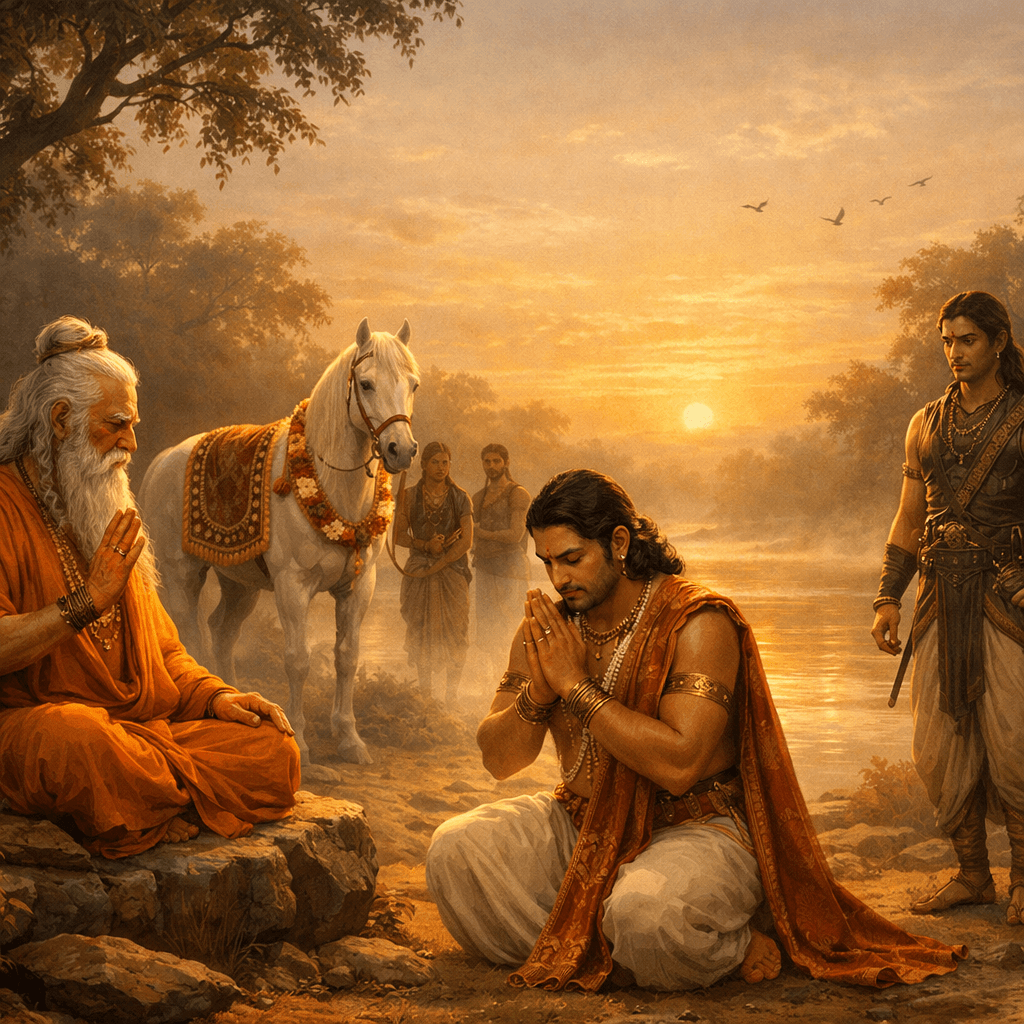
Was Emperor Bharata, son of Dushanta, a relative of the Pandavas?
Yes. Shakuntala was the mother of Bharata. Bharata was installed on the imperial throne in the Hastinavati Palace at a very young age, just after crossing nine years, being the legal heir after his father, Dushanta.
Bharata had performed 1,800 (one thousand and eight hundred) Ashvamedha Yagas. “न द्वादशी समं तिथिः” meaning: in the lunar calendar, the twelfth day is called Dvadashi, and it is always the most auspicious day. Even though Bharata was a young, unmarried prince, there were procedures, as well as experts in the ritual methods, to conduct the famous Ashvamedha Yaga. He received blessings from his efficient and able mother, Shakuntala.
Hence, on every Dvadashi day, Bharata conducted the Ashvamedha Yaga; in a year, he used to do it twenty-five times. Such Yagas were continuously done by him for more than seventy-two years, totalling one thousand and eight hundred Ashvamedha Yagas. He had crossed the age of eighty-two when he had witnessed one thousand full-moon nights.
People in India celebrate when they have seen a thousand full-moon days, and it is called Sahasra Chandra Darshana Yoga. Hence, after the completion of 1,800 Ashvamedhas by Bharata, without causing any war or violence, the Rishis named this nation Bharata Varsha. Later, Emperor Bharata became Bharata Muni.
Vyasa told this old reference to uphold the importance of preserving Sanatana Dharma forever, and also to honour the late Bhishma, the son of Ganga. He was consoling Yudhishtira after the war.
Why did Vyasa suggest to Yudhishtira to perform the Ashvamedha Yaga?
Yudhishtira was feeling very sorry about the Mahabharata war, due to the heavy loss of many lives and assets during the fighting. So, he fell unconscious on the banks of the River Ganga after walking a few steps.
When he regained consciousness (after Ganga water was sprinkled over his face), Vyasa suggested that Yudhishtira perform the Ashvamedha Yaga. He deserved to do Ashvamedha. In the presence of Arjuna, Vyasa advised him to heal from the wounds of war.
Why was Arjuna used as the witness for Vyasa’s advice for Ashvamedha?
Arjuna had learned the Indian dance called Bharatanatyam, and he had worked as a teacher of Bharatanatyam in the palace school of King Virata. Arjuna knew about the one thousand and eight hundred Ashvamedhas of the old Emperor Bharata. Hence, Arjuna was used as the witness for Vyasa’s advice regarding Ashvamedha.
Vyasa also knew about Prince Babruvahana, and that would be described in the next Upa Parva.
What was suggested to Yudhishtira for procuring the required wealth?
Vyasa knew the past, present, and future. Therefore, he informed Yudhishtira about deposits of gold, silver, gems, and jewels kept hidden at a secret place in a Himalayan cave. These valuables were received by the Rishis (including Vyasa) during the reign of Emperor Marutta, but were simply stored there for future use, whenever such a situation warranted.
Hence, it was a secret reserve, notified by Vyasa for Yudhishtira. Vyasa recommended that he perform the Ashvamedha Yaga without causing any war or violence. That cave was later covered by icebergs in the Himalayas. Vyasa told Yudhishtira to procure that secret reserve for his use.
What was the side story of Marutta told by Vyasa?
Marutta was the emperor of Bharata Varsha, and he desired to perform the Ashvamedha Yaga. Brihaspati had been officially appointed as priest by Devendra. If Marutta performed more than one hundred Ashvamedha Yagas, then he would become eligible to sit on the seat of Devendra; as a result, Devendra would have to quit his seat and take birth as an ordinary creature.
To safeguard his position, Devendra instructed Brihaspati not to perform Marutta’s Ashvamedha Yaga. Marutta still desired to conduct the Ashvamedha Yaga, but as he had been discouraged earlier by Devendra, Brihaspati refused to perform it for him.
Marutta still hoped to do it and began searching for an expert priest with good knowledge of the Vedas to perform the rituals. Thus, later Marutta conducted the Yaga, and hence the side story.
Who was Brihaspati? Who was Samvarta? What did Narada advise?
Brihaspati was the elder son of Angirasa Rishi. Samvarta was the younger brother of Brihaspati. Their father taught them equally, all the Vedas. Later, Brihaspati was officially appointed as priest by Devendra.
To deserve the higher status of being the befitting priest for Devendra, Brihaspati used all the landed assets, along with his father’s chariot, and he was shining and well-prepared in the court of Devendra. Samvarta was unmarried and not interested in a life of luxury, but he was an expert priest with good knowledge of the Vedas, capable of performing rituals.
Narada advised Marutta to meet Samvarta to conduct the Ashvamedha Yaga.
How did Marutta recognise Samvarta, and how was the Yaga completed?
Marutta asked Narada how to find Samvarta, since he had no residence. Narada was always travelling, and similarly, Samvarta was also always travelling.
Narada told Marutta that once a year, Samvarta would visit the Vishwanatha temple at Varanasi, after taking a bath in the River Ganga, and that day would be the annual death-ceremony day of his father, Angirasa. But thousands of people visited Lord Vishwanatha daily; therefore, Marutta needed a clue to identify Samvarta.
After bathing in the River Ganga, Samvarta would directly come to the temple. Marutta should place a dead body on his way near the gateway that day; immediately on seeing it, one man would run away like a madman. Marutta was an emperor, so he followed all the instructions of Narada with the help of his royal servants. Marutta recognised Samvarta as Narada had told.
At first, Samvarta placed certain terms and conditions. Marutta had already obtained permission from Brihaspati, as he was Samvarta’s elder brother. Finally, the Yaga was arranged by Marutta, with Samvarta as the priest. The Ashvamedha Yaga was done by Marutta, and many Rishis (including Vyasa) attended it.
Marutta announced that he would not require the seat of Devendra, and still, he conducted more than one hundred Ashvamedha Yagas. Marutta performed many Yagas, and later Brihaspati and Devendra also attended his palace. He donated many valuable items.
What was done by the Rishis with the gems, gold, and silver of Marutta?
During the reign of Emperor Marutta, many Rishis (including Vyasa) received valuable movable assets, but they simply stored them for future use, at any time, in a secret Himalayan cave. This was the secret reserve that Vyasa later revealed to Yudhishtira.
Hence, Vyasa recommended doing the Ashvamedha Yaga without causing any war or violence. The cave was later covered by icebergs in the Himalayas. Yudhishtira, with his brothers, procured that secret reserve.
What did Bhishma opine to Yudhishtira about Ashvamedha?
यो यजेताश्वमेधेन मासि मासि यतव्रतः।
वर्जयेन्मधु मांसं च सममेतद् युधिष्ठिर ॥
Bhishma told Yudhishtira that in every fortnight (meaning on all Dvadashi days, twice per lunar month), performing the Ashvamedha Yaga, without any flesh or meat, provides virtue. The Ashvamedha ritual should be done without the use of any alcohol or meat. Bhishma had already managed to do three hundred similar Ashvamedhas.
What did Arjuna request Krishna during discussions in Indraprastha?
Arjuna requested Krishna to tell the essence of the Bhagavad Gita once again, since Arjuna had forgotten most of the verses. Krishna then told it in an abridged form, and it was named Anugita. The Anugita underwent many editions, and the available verses are not fully reliable. The original Bhagavad Gita has clarity.
How did Krishna repeat the Bhagavad Gita, called Anugita?
In the Indraprastha palace, Arjuna was spending time happily with Krishna. Krishna said it could not be repeated exactly as the original doctrines told on the battlefield. The Bhagavad Gita retold in Indraprastha to Arjuna was called Anugita.
Krishna explained many principles to Arjuna. He told the original Bhagavad Gita on the battlefield with the exhibition of Vishwaroopa, suitable for that occasion. But in the Anugita, no Vishwaroopa was shown by Krishna in Indraprastha; instead, he simply discussed the essence of yoga life.
What was the most impressive story-subject told by Krishna to Arjuna then?
The most impressive story-subject told by Krishna was about the Ashvamedha of Emperor Bharata. Bharata had completed one thousand and eight hundred Ashvamedhas at Hastinavati. Krishna encouraged Arjuna to help Yudhishtira in completing the Ashvamedha Yaga. Arjuna was sorry about the war, and hence he was consoled.
Who was Kashyapa and Siddha-purusha?
Kashyapa was a person curious to learn about the existence of God. Siddha-purusha was a learned person speaking with a common man. Kashyapa secretly observed the Siddha-purusha talking with that man and then decided to seek a scholarship under the Siddha-purusha. The Siddha-purusha was happy to accept Kashyapa as his disciple.
Krishna continued the narration, like a speech from Siddha-purusha, explaining to Kashyapa. Finally, after telling many principles about the divine status of Siddha-purusha, Krishna declared that anybody could become like Siddha-purusha, but it would take a millennium.
Then Arjuna asked Krishna who Siddha-purusha was and who Kashyapa was. Krishna smiled and replied: Krishna was Siddha-purusha, and Arjuna was Kashyapa.
In the Indraprastha court hall, Arjuna and Krishna spent a day happily. That palace was built with the help of Krishna for the Pandavas, along with the court hall. Yudhishtira was crowned here during the Rajasuya Yaga. More details are available on this website in Sabhabhavana Parva. When Yudhishtira forgot Krishna during the dice game, the Indraprastha Palace was lost.
What did Krishna desire finally in the Indraprastha palace, to be done by Arjuna?
Krishna finally desired to go to Dwaraka. Therefore, he hinted that Arjuna should ask Yudhishtira’s permission. Krishna said he would travel together with Arjuna.
As the Ashvamedha Yaga was under consideration, Krishna desired to give good donations for the success of Yudhishtira’s Ashvamedha Yaga, and he would persuade his brother Balarama. So, Arjuna tried to meet Yudhishtira.
Why did Arjuna not travel to Dwaraka with Krishna?
Yudhishtira permitted Krishna to go to Dwaraka with Subhadra. Yudhishtira also desired Arjuna to go and collect donations from other kingdoms. Arjuna followed the Ashvamedha horse and did not travel with Krishna.
What did Krishna do in Uttankopakhyana?
Krishna started his journey with Subhadra to Dwaraka. On his way, Arjuna praised Krishna for his divine blessings and for providing success in the war. Arjuna then diverted his journey towards the east, following the Ashvamedha horse; but Krishna travelled slowly with Satyaki and Yuyudhana towards the west, to Dwaraka.
On the following day, Uttanka Muni visited Krishna on his way. Uttanka desired to know about the progress of Krishna’s peace treaty. But Krishna told Uttanka about the character of Duryodhana and his desire to kill the Pandavas (especially Bhima). Krishna explained how Shakuni, Karna, and Dushasana joined King Duryodhana; thus, Krishna failed in his peace mission, but he was successful in the war, favouring Sanatana Dharma.
Krishna told Uttanka about his attempts to maintain non-violence, but with the Pandavas, he was forced to witness the Mahabharata war. Krishna enquired about Uttanka’s comforts in life, and about the boon needed by him. Initially, Uttanka wished to see the Vishwaroopa Darshana of Krishna.
Krishna explained that by displaying it for a moment, Uttanka would not get benefits, but a boon could help him live a better life while observing Sanatana Dharma. So Uttanka asked for a boon: to pour rain whenever Uttanka remembered Krishna and requested rain for good water. Krishna granted the boon to Uttanka and travelled towards Dwaraka with his Yadava team.
During the discussions between Krishna and Uttanka, some details of Uttanka from the Ramayana period were also taken into account by Krishna, while granting the boon for rain in deserts. Esteemed readers are requested to browse the articles available on this website: “Uttanka in Ramayana and Mahabharata.”
Later, Uttanka joined Astika as a learned priest in the abandoned serpent-sacrifice Yajna. Being learned in the Vedas, he avoided animal sacrifices—hence this history. The role of Uttanka was described on this website in the articles Markandeya Parva and Astika Parva, and also in some other articles. Uttanka lived in Ujwalakashram (the present Jal Mahal premises of Jaipur) as a good teacher.
Who reported to Vasudeva in Dwaraka about the Mahabharata war?
Krishna returned to Dwaraka and reported to Vasudeva about the Mahabharata war in short, after the decision for Ashvamedha at Hastinavati. He omitted the death of Abhimanyu, but later, due to the requests of Subhadra, he disclosed it with some pleasing words.
During the war, Abhimanyu fought with many able warriors. Even though Karna stabbed Abhimanyu from behind, many warriors fought with him; finally, the son of Dushasana also struck Abhimanyu. Abhimanyu was killed in the war. Krishna referred to Dushasana, as Krishna thought it would reduce the sadness of Subhadra and Uttara, and thus he consoled them.
What did Krishna additionally tell Vasudeva about Bhishma?
Krishna additionally told his father Vasudeva about Bhishma, regarding his will and desires. Bhishma disliked the administration of Duryodhana. He wanted Yudhishtira to win the war, and daily morning, he used to bless Yudhishtira for success.
While lying on the battlefield and practising yoga, Bhishma had completely changed his old body (grown under the food provided by Duryodhana). After receiving Krishna’s permission, he advised Yudhishtira on many administrative matters.
Bhishma desired to live a few days under the rule of Yudhishtira; finally, before his last day, he requested sanctions from Yudhishtira for funeral expenditure, and Yudhishtira did it sincerely. Krishna tried to please his father by speaking in alignment with Sanatana Dharma.
What had been omitted by Krishna while speaking to his father, Vasudeva?
Krishna omitted the death of Abhimanyu while speaking to his father, Vasudeva. But a few days earlier, Kunti had already come with Subhadra and informed the ladies of the Dwaraka palace about the death of Abhimanyu and the Upapandavas. Kunti arranged Shraddha and Jalapradanika rituals in honour of Abhimanyu.
As Kunti reminded Krishna, he explained the death of Abhimanyu later. Krishna told it to his father Vasudeva using convincing words. Krishna finally declared that Abhimanyu had gone to heaven with Drona. Krishna consoled the crying people and changed their mindset by speaking about the Ashvamedha to be done next.
Why did Vyasa visit Hastinavati when neither Krishna nor Arjuna were there?
Uttarakumari was very sad after Krishna had gone to Dwaraka, and Arjuna (with the Pandavas) had gone to collect assets for the Ashvamedha Yaga. Vyasa visited the Hastinavati palace then.
Uttarakumari was not taking food, and her body became weak. Vyasa advised her to take sufficient good food and gain good health, as she would give birth to the father of Janamejaya within a few months. Vyasa persuaded the bereaved family with good hope.
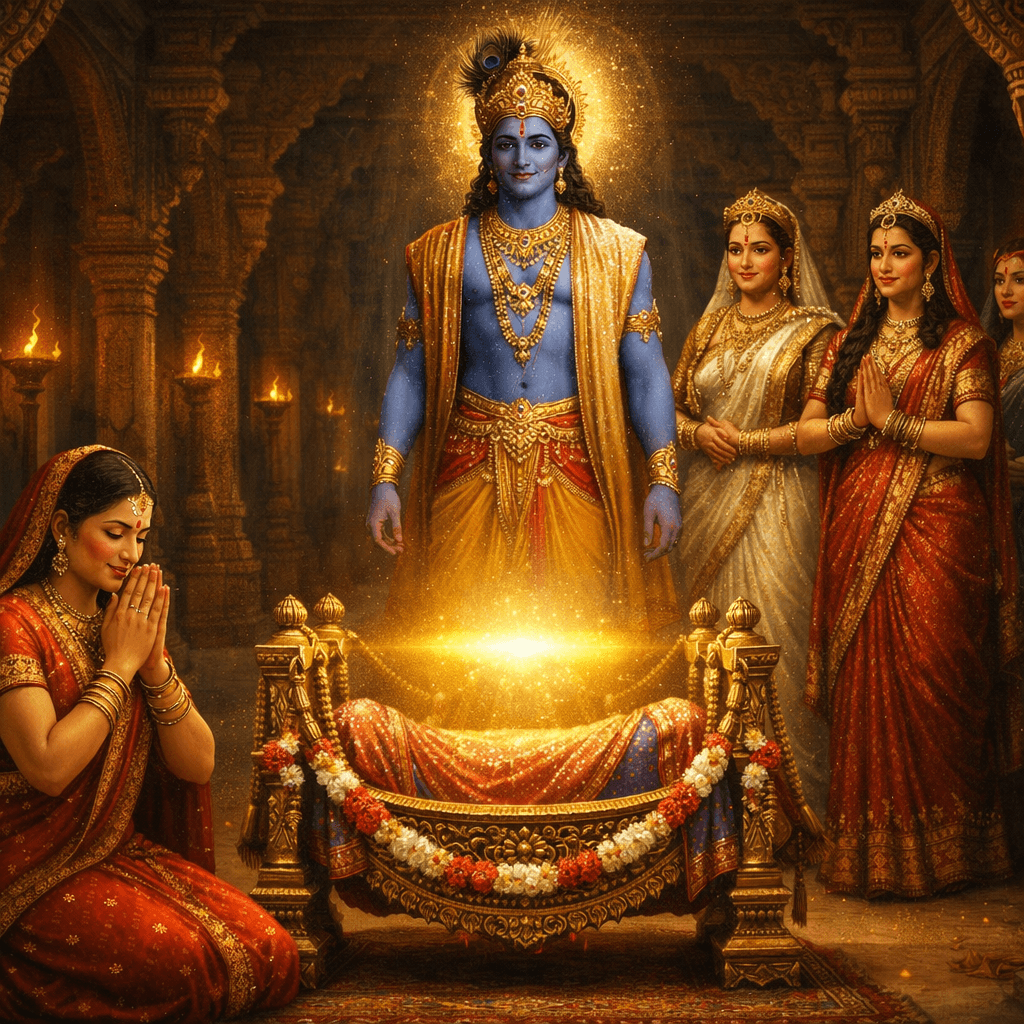
What happened in Hastinavati when Krishna returned again from Dwaraka, and what did Krishna do then?
Vaishampayana replied to Janamejaya that the birth of his father, King Parikshit, happened on that day in Hastinavati, when Krishna returned again from Dwaraka with huge quantities of donations; by his divine powers, the child got life then.
When Krishna returned to Hastinavati, the Pandavas were very happy, as they too were returning home after collecting donations from various kingdoms for the Ashvamedha Yaga. Arjuna returned to Hastinavati one month after the birth of Parikshit. Hence, the city was decorated with flowers and lamps.
It was an auspicious day, but when Parikshit was born, the baby showed no signs of life due to the Aishikastra of Ashwatthama. Hence, the ladies in the palace, along with the medical people of the city, suddenly became silent.
Krishna entered the palace and wished to visit the labour room of Uttarakumari, where she was crying for Krishna’s help to bless the newly born baby. Kunti, Draupadi, and other attendants welcomed Krishna with great reverence and praised him for arriving in time to help the needy.
Crying for divine help, Uttarakumari pleaded with Krishna to restore the life of her baby. Krishna saw the people in desperation, with the baby. He assured Uttarakumari, by the truth of his promise, that he would restore the baby’s life from the bad results of Ashwatthama’s Aishikastra.
Then the baby started to move hands and legs with open eyes. The baby cried first, and Krishna smiled next. Then all the ladies prostrated to Krishna, praising his real and divine powers, seeing the child alive. The news spread quickly in the city of Hastinavati.
The Pandavas were overjoyed and assembled with Yudhishtira. They celebrated the happiness by greeting Krishna. Yudhishtira requested Krishna to assign a name to the child. Krishna examined the baby and named him Parikshit, since in Sanskrit the word for examination is Pariksha (परीक्षा).
What was the main purpose of Ashvamedha?
The main purpose of Ashvamedha was to propagate Sanatana Dharma by eliminating violence and maintaining law and order in society. Animal sacrifice was not mandatory. However, some kings liked to eat non-vegetarian food; hence, separate arrangements were made by the army for them. Proper ruling in compliance with Dharma was assured, bringing happiness to all.
How did the Pandavas procure the hidden wealth (secret reserve) from the Himalayas?
Yudhishtira started with his Pandava brothers, as directed by Vyasa, to procure the movable assets kept as the secret reserve. Yudhishtira dug the earth in the Himalayas at the exact location and collected gold, silver, gems, and jewels. With the help of royal servants, the wealth was taken into custody and transported to the palace treasury. Draupadi later accounted for it.
How did Yudhishtira distribute the works of the Ashvamedha Yaga?
Yudhishtira was advised by Vyasa to make a golden Supasha (a golden bracelet for the right hand) and a golden Koorcha (three golden sticks tied at the top, to cover the idol of Lord Ganapathi). As usual, other items required for the Ashvamedha could also be made of gold.
Then, as per the advice of Rishis, including Vyasa, various works were distributed. Bhima and Nakula would take care of national activities. Sahadeva would take care of the palace and family activities. Arjuna would follow the horse left for Ashvamedha. Then the Pandavas’ Ashvamedha preparations started functioning. Separate special arrangements were made for non-vegetarians.
Why did Arjuna fight with the Trigartas?
Susharma was killed in action during the Mahabharata war. The Trigarta prince was a minor then, but the reserve regiment of Susharma was very strong.
The elder brother was arrogant; hence, he tied the horse and died in the war. Arjuna fought with the soldiers of the Samasaptakas, but they surrendered immediately. The younger prince was then crowned as per the instructions of Yudhishtira. The horse moved ahead.
Why did Arjuna fight with the Saindhavas?
The Saindhava soldiers were prepared to fight, since they could not assess Arjuna. As they tied the horse, Arjuna had to fight with them. Dushala, the sister of Arjuna and the widow of Jayadratha, visited the battlefield and explained about Arjuna to the soldiers. They surrendered, and the horse was left free.
Arjuna invited them to the Ashvamedha Yaga at Hastinavati later.
Why did Arjuna fight with the grandsons of Shakuni?
The grandsons of Shakuni and their soldiers were prepared to fight, since they could not assess Arjuna. As they tied the horse, Arjuna had to fight with them. Later, they surrendered, and the horse was left free.
Arjuna invited them to the Ashvamedha Yaga at Hastinavati later. Then the horse moved to Manipur.
Why did Arjuna fight with Babruvahana?
In the kingdom of Manipur, Babruvahana was ruling. He could not assess Arjuna and tied the horse. Arjuna fought with Babruvahana and failed due to a curse by Ganga. More details will be described in the next article, Babruvahana Parva.
Next post, Mahabharat: Babruvahana Parva would be more interesting.
Mahabharat: Ashramavasa Parva would be presented separately in another article.
What are the benefits of reading this story?
On reading this story, children would gain more memory power, great moral strength in their lives in future; creating a sense of self-reliance, leading to peace and progress.
It is humbly prayed for the blessings of God Krishna upon us.
Readers may share this story with children, friends and family.
Leave a Reply