
Swargarohana Parva is the ninety-eighth Upa Parva included in the eighteenth Maha Parva, named as Swargarohana Parva. The eighteenth Maha Parva has only one Upa Parva. Vaishampayana continued narration to Janamejaya in reply to his queries as follows.
What did Yudhishtira discuss with Narada when he greeted him in heaven?
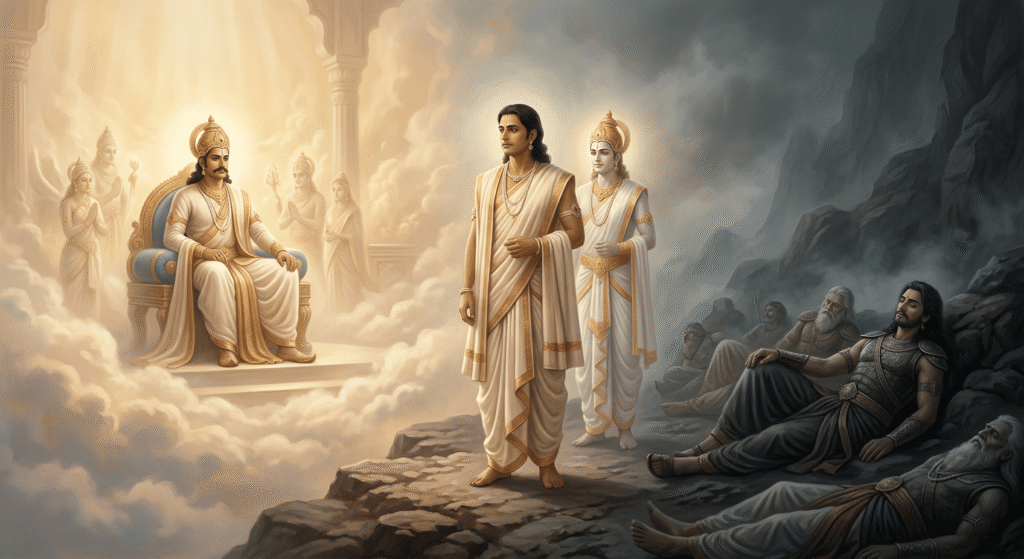
Yushishtira intended to see Karna in heaven, but instead, he saw Duryodhana with high pomp and show, shining in heaven. Yudhishtira asked Narada for the location of his brothers. Then, one servant of Devendra had escorted Yudhishtira to hell, and he showed Karna and others lying in hell.
Why did Yudhishtira have to visualise hell?
Yudhishtira had been responsible for the death of Drona in the war. The announcement by Yudhishtira was a misleading statement about the death of the elephant Ashvathama.
Thus, he deserved to see hell as an illusion with Karna lying there. Devendra explained to Yudhishtira the principles of sins and virtues, to be experienced in hell and heaven with respect to the works done in life.
Why did Yudhishtira abandon his physical body in the river Ganga?
Devendra had shown the holy river Ganga to Yudhishtira and instructed him to take a bath in it to be deserving of seeing his brothers in the real heaven. Then, Yudhishtira had taken a dip in the river Ganga. He abandoned his mortal body and rose to heaven. Yudhishtira was happy; his soul had been put in heaven with peace.
How did the history of the Mahabharata end happily at Takshashila?
After Devendra had shown the people of Mahabharata to Yudhishtira in heaven and explained about the tenure periods, with permission of Vyasa, the history of the Pandavas had concluded.
Later, Vaishampayana assured, hearing or retelling of this history would fetch virtues both to the listener and the narrator. It had ended happily at Takshashila with live Takshaka, the serpent. Neither horse was killed, nor was a serpent offered to fire. Ugrashrava was the son of Lomaharshana Rishi and retold this history to Shaunaka and other Rishi people gatherings at Naimisharanya later.
What is Bharatasavitri?
Bharatasavitri means the Mahabharata history, told by the Rishi people to other people.
Why was Takshashila selected for the Sarpayajna by Janamejaya?
The Palace at Hastinavati was under renovation after a flood. Moreover, Takshashila was the favourite place for Takshaka, the leader of the Serpents. Hence, Janamejaya had selected Takshashila for the oblation.
It had been the end of observing non-violence. On the Ashlesha star, no sacrifice of a serpent was done in Takshashila. All the Rishi people were happy, along with the palace people there.
Esteemed readers are kindly requested to read the article on this website on ‘Paushyaparva’. In the Paushyaparva, Pareekshit is referred to as the great-grandson of Arjuna.
Why did Janamejaya return to Hastinavati after Sarpayajna?
विसर्जयित्वाविप्रांस्तान्राजाऽपिजनमेजयः।
ततस्तक्षशिलायाःसपुनरायाद्गजाह्वयं॥
After distributing the donations to the priests of the Sarpasatra at Takshashila, Janamejaya returned to Hastinasvati again. By that time, the old palaces had been fully renovated. The Suta Puranikas had gone to Naimisharanya. They had propagated the Mahabharata history later sitting in Naimisharanya.
How did the Mahabharata story end?
The Suta Puranikas at Naimisharya had also conducted the Satra to propagate the same story later, after returning from Takshashila. Several Rishis had attended the same assembly. The Mahabharata story ends there but it starts again as retelling to their juniors.
It was in Naimisharanya that all the Puranas were retold. Bhagavata Purana was retold as the last remainder part of Mahabharata history. The life story of Krishna was the main content of Bhagavata Purana. Due to rulings of several genealogies in India, the same had been edited to please the rulers more.
During the predominant era of the Jain kings, the Purana got the name Harivamsha Purana. Later Buddhist, Islamic and Christian rulers also influenced the literature. Thus, Bhavishya Purana resulted as the hundredth upa parva. Both Harivamsha Purana and Bhavishya Purana were told in the end as appendices (Khila).
Why was Naimisharnya selected as the venue for reciting the histories to Shaunaka and other Rishi people by Ugrashrava Rishi?
Naimisharanya was the venue selected by Shree Rama for conducting his Ashvamedha yaga in Treta yuga. Then, the hermit of Valmiki and the venue of that yaga were within walking distance.
Kusha and Lava, reciting Ramayana, attended Ramashvamedha daily under the instructions of Valmiki. It was in Sitapur District. Considering all the holy aspects, Ugrashrava Rishi had selected the same place near Gomati River banks for reciting histories to Shaunaka and other Rishi people.
For how many years did Duryodhana and Yudhishtira rule India?
Duryodhana had ruled for twenty five years and Yudhishtira had ruled for thirty five years. The story part of Mahabharata continued with two annexures. These two books were Harivamshapurana and Bhavishyapurana.
What were the differences in the ruling of Duryodhana and Yudhishtira?
During the period of ruling of Duryodhana, Karna was really executing the administrative works. Dritarashtra was his father but not honored suitably. Bhishma was monitoring the general public, confirming the satisfaction but was struggling to keep peace under Dritarashtra’s Empire.
During the period of ruling of Yudhishtira, Dritarashtra was honored suitably, really executing the administrative works for the initial fifteen years. Yudhishtira allowed him to go on with his desires to make him happy to the maximum.
In the last twenty years, Yudhishtira was ruling with the help of Bhima and following the Viduraniti code for penal purpose. He had ruled his empire assuring freedom and happiness of the people.
Next post, Mahabharat: Khila Harivamsha Purana would be more interesting.
Mahabharat: Khila Bhavishya Purana would be presented separately in another article.
What are the benefits of reading this story?
On reading this story, children would gain more memory power, great moral strength in their lives in future; creating a sense of self-reliance, leading to peace and progress.
It is humbly prayed for the blessings of God Krishna upon us.
Readers may share this story with children, friends and family.
Leave a Reply