
Babruvahana Parva is the ninety-second Upa Parva included in the fourteenth Maha Parva, named as Ashvamedhika Parva. Vaishampayana continued narration to Janamejaya in reply to his queries as follows.
How many Upaparvas are there in the Ashvamedhika Maha Parva?
Ashvamedhika Maha Parva contains two Upa Parvas. They are Ashvamedhika Upa Parva and Babruvahana Upa Parva. In this second Upa Parva, the yaga was completed.
How were the preliminary preparations done, and how did it succeed?
Similar to the preparations done for the past Rajasuya yaga, the Pandavas had done the preliminaries under the guidance of Vyasa. Arjuna had moved to various directions to collect movable assets, wealth and food for the yaga ceremonies.
Arjuna had not interfered in the freedom of any kingdoms but assured, under Sanatana Dharma, absolute freedom to all, with law and order. Protection was guaranteed for life on the entire earth for the righteous. The horse was followed by Arjuna with protocol, but with few soldiers. Krishna had supported the Pandavas to conduct the Ashvamedha yaga, pleasing all the angels and people.
Why did Krishna instruct Yudhishtira to conduct the Ashvamedha yaga?
Krishna knew that some of the minor children of the deceased kings would be crowned after the Mahabharata war ended. Out of the eleven Akshohini soldiers who visited Kurukshetra, none of them were alive, but the reserve troops in the respective palaces were protecting their kingdoms, with princes being babies. It was necessary for the smooth administration of Yudhishtira to invite them all, honour them as justified by law and orders by means of an Ashvamedha yaga.
Hence, for the purpose of Ashvamedha, Arjuna was sent with the ‘free-horse’ with a small troop of soldiers for protection. All the opposing kings were brought in line under his protection, removing their hidden misunderstandings. It was a subject of Krishna for satisfying Chitrangadha and Babruvahana. They were invited to Hastinavati.
Why did Arjuna become unconscious when his son Babruvahana had fought?
Babruvahana was a powerful prince of Manipura. Chitrangadha was his mother, and he was given a good education in administration by his minister, he being an old man. When Arjuna followed the Ashvamedha horse continuously, one day it entered the kingdom of Manipura. The original name of Babruvahana was Chitravahana, and after crowning, he was called as Babruvahana. He had tied the horse and ordered his minister to arrange the soldiers on the following day to fight with Arjuna using his soldiers.
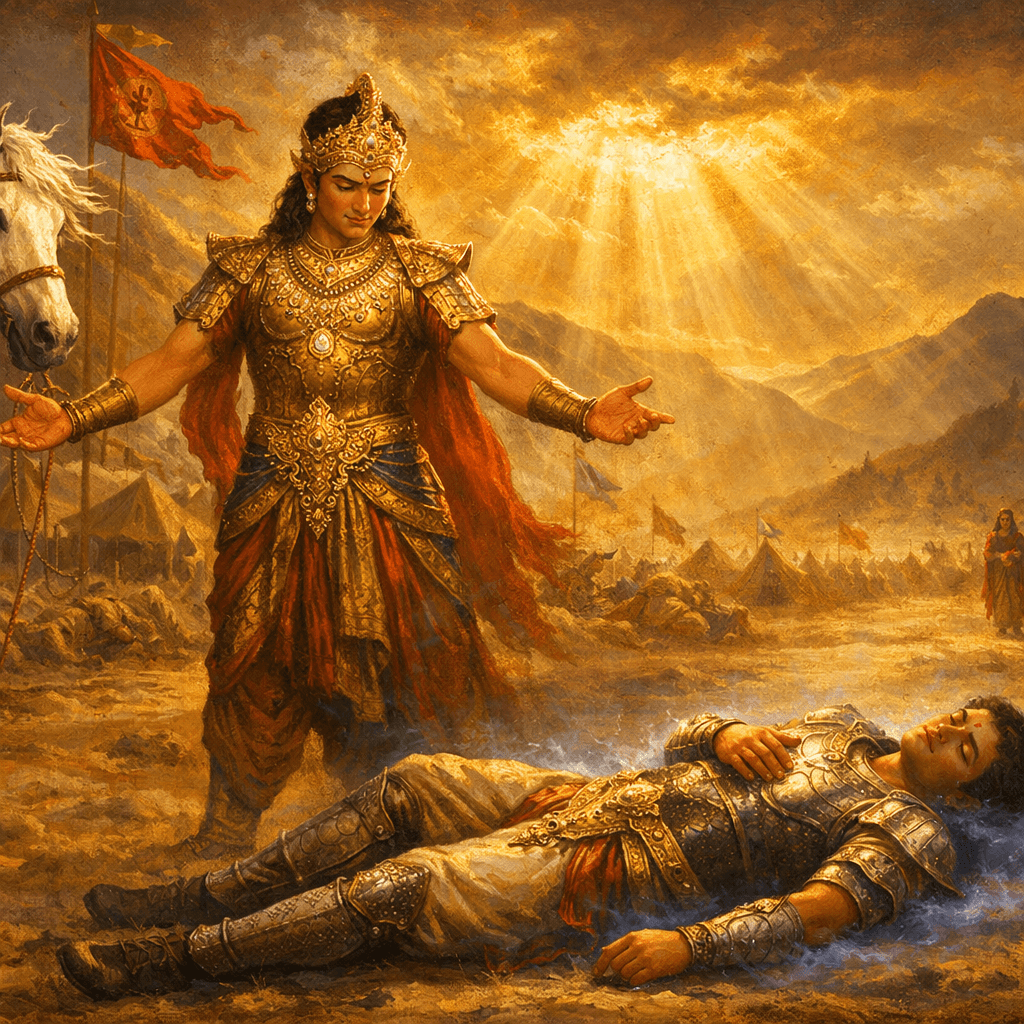
On the following day, the war started and due to the powerful attack by Babruvahana with his soldiers, the soldiers of Arjuna were defeated. Arjuna had become unconscious when his son Babruvahana had fought with him. Arjuna was defeated by his son due to the old curse of the Ganga River.
Why did Queen Chitrangadha visit the battlefield at Manipura?
The minister was brave and knew about Arjuna being the father of Babruvahana. More details would be available in the Arjuna Vanavasa Parva on this website. The Minister had sent his messengers to Queen Chitrangadha. They told about the defeat of Arjuna by Babruvahana on the battlefield. Chitrangadha had visited the battlefield at Manipura and arranged to stop the war. Chitrangadha had shown Babruvahana his father being Arjuna. Babruvahana surrendered before Arjuna.
Why did Arjuna leave Manipura without visiting the palace?
Within a limited period of time, Arjuna was to collect the maximum assets for the purpose of the Ashvamedha yaga of Yudhishtira. He invited Chitravahana, Queen Chitrangadha and all the concerned people, including the old minister, to attend the Ashvamedha yaga to be held in the Hastinavati palace.
Arjuna had to follow the horse, so he left Manipura without visiting the palace. His old curse of the Ganga River was nullified. He was happy, and the horse had entered the kingdom of Jarasandha.
Why did Arjuna fight with the son of Jarasandha or Meghasandha?
Bhima had faced Jarasandha in a wrestling fight prior to the Rajasuya yaga by the Pandavas, and later, the elder son of Jarasandha also faced Bhima in the Mahabharata war.
When the Ashvamedha horse entered the Magadha kingdom, the younger son was a prince, and his name was Meghasandha, but they followed demonic principles and tied the horse. Arjuna fought with Meghasandha, the younger son of Jarasandha, and defeated him. Arjuna invited him to the yaga with the surrendered soldiers.
After circumscribing the Earth, where did the horse go?
After circumscribing the Earth, the Ashvamedha horse had started to return to the Hastinavati palace. The horse remembers its stable, is a proverb. The horse returned to the Hastinavati Palace after a month following the birth of baby Pareekshit.
What messages did Arjuna send to Krishna before reaching Hastinavati?
Arjuna had sent a request message to Krishna before reaching his palace to arrange some gifts to honour Babruvahana with Chitrangadha.
After how many months did Arjuna return to Hastinavati following the birth of Pareekshit, with the collection of the donation for the Asvamedha?
Krishna had visited Hastinavati with huge quantities of donations. On that day, Pareekshit was born, and it was due to the divine powers of Krishna that the newly born baby got life.
After one month, the Yaga horse returned and arrived at Hastinavati, followed by Arjuna. Arjuna had entered the palace with huge quantities of donations. Arjuna was very happy to see his family and to hear the good news.
What had Bhima done for the Ashvamedha?
एतस्मिन्नेवकालेतुद्वादशींमाघपाक्षिकीं।
इष्टंगृहीत्वानक्षत्रंधर्मराजोयुधिष्ठिरः॥
The Pushya star day, inclusive of Dwadashi lunar day, was selected by the emperor, Yudhishtira, and he called his brothers. He ordered Bhima for arrangements. That month was Magha, and the full moon day was approaching.
Bhima had sent messengers to many kings. He arranged tents for food and rest. He arranged for the parking of the chariots of visitors. He arranged for donations during the Ashvamedha. Bhima had arranged for separate arrangements for the vegetarian food supply with their dress codes for Krishna and Rishis.
After the return of Arjuna, Arjuna was assigned the task of a vegetarian food system. Bhima was taking care of the black horse meant for the Ashvamedha, and soldiers were vigilant. Bhima had arranged for the successful completion of the Pandavas Ashvamedha.
भोजनं भोजनार्थिभ्यो दापयामास नित्यदा ।
भीमसेनो महातेजाः सततं राजशासनात् ॥
Those who desired to eat food, as per orders, Bhima had arranged them daily.
How was the beginning of Pandava Ashvamedha described by Vyasa?
Vyasa had described the Pandava Ashvamedha in a very pleasing style of words, in Sanskrit verses, in his ‘Jaya’. In the beginning, twenty-one tree trunk posts of various trees were posted, with a Ganapathy visual idol in the centre.
The Koorcha (three golden sticks, tied at the top) was placed on the head of that idol by Vyasa. The priests, including his disciple Paila, had recited the Vedic hymns. Then, Yudhishtira sat in front of the idol with Droupadi.
The Supasha (Golden bracelet) was tied to the right hand of Yudhishtira after worshipping God and the elders by Vyasa. The yaga venue was decorated with gold and gems. The tree posts were also decorated with golden garlands. The vegetarian items were supervised by Arjuna. The non-vegetarian items were supervised by Bhima. The gold and gem-decorated items were supervised by Draupadi.
Bhima had arranged for an additional three hundred animals for worship. The black horse was also worshipped. The Rishi people were engaged in fire worship, there being four different fire altars. At different corners, dance and music entertainment were also arranged.
What did Babruvahana do when the Ashvamedha was going on?
Babruvahana, along with his old minister, had entered the yaga venue. Ulupi and Chitrangadha accompanied him. As per the instructions of Yudhishtira, Krishna had honoured Babruvahana with a golden chariot tied with attractively decorated horses. Babruvahana had saluted Dritarashtra, worshipped Vyasa and all his elder relatives, including Krishna. He accepted the gifted chariot. Arjuna was happy.
Why was the divinity of grains preferable to Yudhishtira’s Ashvamedha?
Yudhishtira was the emperor, and he desired to satisfy all the people. In the Ashvamedha of Yudhishtira, he had to satisfy his brother Bhima and his relatives with guests also. Some of the kings who visited the Ashvamedha venue liked to eat meat and non-vegetarian food. In Yudhishtira’s Ashvamedha, the black horse was sacrificed, and Bhima with interested kings, were supplied with their desired food, including meat.
Then, Dhaumya, Kripa, Krishna, and Arjuna were supplied with vegetarian food. Bhishma and Krishna had already declared that the divinity of grains or seeds was preferable to horse sacrifice in Ashvamedha. But Bhima, with his soldiers and some of the kings, liked horse sacrifice.
Being Yudhishtira, the responsible king had ordered for the separate arrangements for Rishi people desiring only vegetarian food. The king of Vidarbha was honoured during the Ashvamedha for his vegetarian faith, as per the desire of Bhishma.
What did a disguised Dharma do before the actual sacrifice of the living horse?
Dharma had disguised himself as a mongoose and then appeared before Yudhishtira. As a conversation between a teacher and his disciple, there was a debate on non-violence. Then, barley grains could be used in the yaga instead of the sacrifice of animals, which was preferred by the Pandavas. Except Bhima, the Pandavas always preferred vegetarian food.
After one year of starting the collection of assets with wealth and food gathering in the premises of the Hastinavati palace, earmarked for the Ashvamedha of the Pandavas, it was proposed to conduct with gorgeous shows, including donations to the deserving Rishi people.
Yudhishtira had conducted the Rajasuya yaga, hence he knew how to do it. This time, there was no Duryodhana, but his father, Dritarashtra, was there. Later, Dritarashtra had actually started to get involved in the real administration.
What was the most praised mode of yaga that Agastya had shown?
बीजयज्ञो मयायं वै बहुवर्षसमाचितः ।
बीजैः कृतैः करिष्ये च नाऽत्र विघ्नो भविष्यति ॥
Agasthya was a Brahmin and preferred vegetarian food. Agasthya had supported the yajna to be conducted with seeds, by offering seeds in the rituals, without violence.
Who was the most honoured king as a guest in the yaga and why?
The king of Vidarbha was the most honoured king as a guest in the yaga since he was already appreciated by Bhishma and eligible as a model king. Esteemed readers could get the facts in the Mokshadharma Parva on this website.
Who was honoured with gifts as a prince but not as a guest in the yaga and why?
The king of Manipura, Babruvahana, was the honoured prince with gifts arranged by Krishna, being the son of Arjuna, but not as a guest in the yaga since he was already requested by Arjuna and eligible for the same. Esteemed readers could get the facts in the Arjuna Vanavasa Parva on this website.
How was the completion of the Pandava Ashvamedha described by Vyasa?
Vyasa had described the completion of the Pandava Ashvamedha in a wonderful style of words, in Sanskrit verses, in his ‘Jaya’. In the final rituals, it was estimated by all that the gold and other assets distributed by Yudhishtira would be sufficient for conducting three Ashvamedha yagas.
Yudhishtira said that the entire earth was won by Arjuna, and it would be donated to Vyasa, but Vyasa told him he would be happy to receive golden coins instead of landed assets. So Yudhistira had donated huge quantities of golden coins to Vyasa.
Vyasa had distributed them within his team. Blessed by virtuous deeds, three times of Ashvamedha, Yudhishtira felt very happy being rid of all his sins after the Mahabharata war, and ruled peacefully.
Next post, Mahabharat: Ashramavasa Parva would be more interesting.
Mahabharat: Putradarshana Parva would be presented separately in another article.
What are the benefits of reading this story?
On reading this story, children would gain more memory power, great moral strength in their lives in future; creating a sense of self-reliance, leading to peace and progress.
It is humbly prayed for the blessings of God Krishna upon us.
Readers may share this story with children, friends and family.
Leave a Reply