
Putradarshana Parva is the ninety-fourth Upa Parva included in the fifteenth Maha Parva, named as Ashramavasika Parva. Vaishampayana continued narration to Janamejaya in reply to his queries as follows.
What did Vyasa offer to Dritarashtra in the forest?
Before the start of the Mahabharata war, Vyasa had granted Sanjaya the divine capacity of vision to describe the war proceedings to the blind king Dritarashtra. In his old age, Dritarashtra started his penance in the forests, near the Ganga river bank.
One day, after the evening prayers, Vyasa appeared before Dritarashtra and told him he could offer him a boon. So Dritarashtra was free to ask for anything, and Vyasa would fulfil it.
What were the desires or sorrows of Dritarashtra, Gandhari and Kunti?
Vyasa could read the hearts of Driatarshtra, Gandhari and Kunti. Krishna had already announced the following verse in the Bhagavadgeetha before the war.
अव्यक्तादीनि भूतानि व्यक्त मध्यानि भारत ।
अव्यक्त निधनान्येव  तत्र का परि देवना ॥
Meaning (See Bhagavadgheetha, II-28): Before the birth, the body-life was spread in different Pancha Bhuta forms. After death, the mortal body would again spread into different Pancha Bhutas forms. Between the period of birth and death, the life in the people’s body is clearly manifested, so why should one feel sorry for death? Hence, nobody should worry.
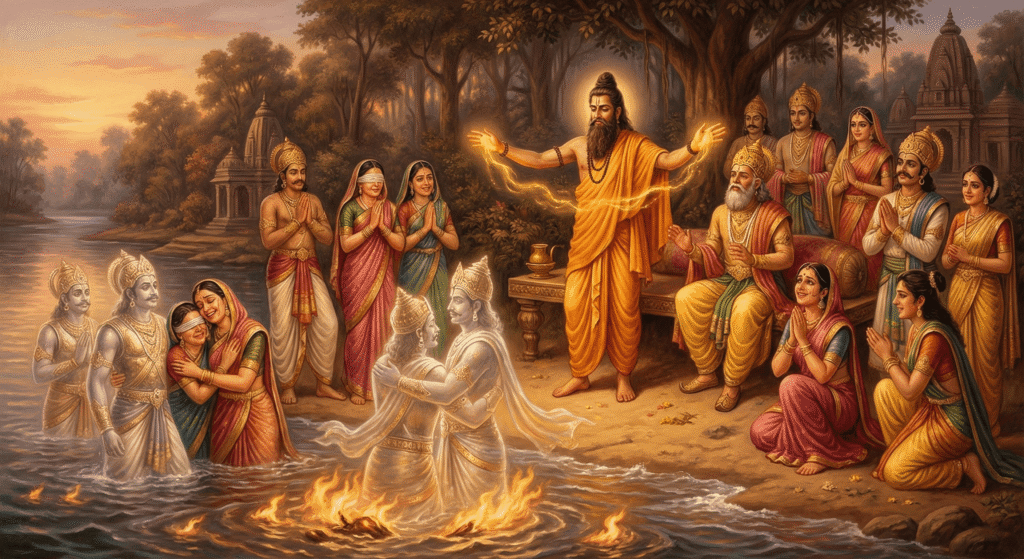
Vyasa tried to console the people in the forest doing penance. Vyasa wanted to prove two things. As the first one, he desired to prove that the penance was wonderfully powerful. Secondly, he could show the dead persons, just as they had been when alive, in good health, just before their death, proving the soul to be ever permanent.
This would prove indirectly that all the incarnations of Vishnu, like Rama or Krishna, always manifested in this nature. Vyasa desired to make all living people happy. They desired to see their children and brothers who had died in the Mahabharata war.
How was Dritarashtra able to see his sons at night?
धृतराष्ट्रस्य च तदा दिव्यं चक्षुर्नराधिप ।
मुनिः सत्यवतीपुत्रः प्रीतः प्रादात्तपोबलात् ॥
With the power of penance, Vyasa had provided Dritarashtra the ability to view the scenery of persons who appeared on the Ganga River bank. Gandhari was also able to see all her sons who had died on the Kurukshetra battlefield.
Vyasa had disclosed the hidden desires of Kunti. What were they?
Vyasa told Kunti had hidden her desires. She had the desire to see Karna, all Upapandavas, Shikhandi and Drishtadyumna. Vyasa had published her desires.
What was done by Vyasa during the Putradarshana show?
Vyasa had requested them to assemble on the banks of the River Bhageerati after their evening prayers. Vyasa had instructed them to have a dip in the water, and all could see whom they desired.
Then, Dritarashtra could see all his hundred children. Dushala could see her husband, Jayadratha. Draupadi could see all her five children, known as Upapandavas. Droupadi could also see all her brothers, Shikhandi and Drishtadyumna. Duryodhana and his brothers were seen by all the Pandavas, with their hundred children.
Bhurishrava, Karna and Shalya could be seen with Virata and all his children. Shakuni was seen there. Gandhari was satisfied to see her hundred children. Arjuna could see Ghatotkacha there, and Vyasa had shown all the desired persons there. The view was a wonder, and it was supported by King Yudhishtira, including the Palace people.
What were the three wonderful verses written by Vyasa for Kripi?
In the Putradarshana Parva, Vyasa had written three wonderful verses about Kripi. She was the widow of Drona and the sister of Kripa. Yudhishtira arranged her visit.
ततस्ते पार्थिवाः सर्वे भीष्म द्रोण पुरोगमाः ।
ससैन्याः सलिलात्तस्मात्समुत्तस्दुःसहस्रशः ॥
There had been thousands of persons desired by the gathering, like Bhishma, Drona and most of the desired soldiers, being the husbands of the widows, there.
पुत्रः पित्रा च मात्रा च भार्या च पतिना सह ।
भ्राता भ्राता सखा चैव सख्या राजन्समागताः ॥
Children had seen their father and mother. Kripi could see Drona, her husband, there, and he could communicate with his wife. The brothers and friends could see each other and talk with pleasing words. O Rajan, the meeting was really done.
एवं क्रमेण सर्वास्ताः शीलवत्यः कुलस्त्रियः ।
प्रविश्य तोयं निर्मुक्ता जग्मुर्भर्तृसलोकतां ॥
Happily, they talked to one another. Gradually, some of the widows decided to go with their husbands. Kripi had taken a dip in the water, and she joined Drona. She had gone to heaven with him.
Vyasa had written the above verses. So Kripi had gone to heaven with Drona, as seen by all.
After the second dip in the water, what happened when they got satisfied?
After the second dip in the water, at the end of that night, the wonderful vision disappeared from the view of a few widows. Kunti and Yudhishtira had seen Karna and were satisfied.
What was the challenge to Vaishampayana as told by Janamejaya?
Janamejaya could not believe the wonderful words of Vaishampayana. He put his doubts before him. If the dead children or the dead parents of the princes could be shown again, he doubted why his father, Parikshit, could not be shown again in that same assembly, which he asked about there.
Then, Vaishampayana called his teacher Vyasa there and requested the need to show Parikshit there. Vyasa had appeared there, and he started to show Parikshit with Rishi Shamika and his son Shringi. His old minister was also there, and Takshaka had appeared with folded hands there.
Janamejaya was convinced. He had paid the fees to Asthika and satisfied him. In the assembly of priests, Uttanka was sitting there as a witness to the phenomena. Then, Janamejaya had arranged to worship Vyasa by Uttanka and allowed him to take leave. Thus, Takshaka was happy, and no serpent was killed.
How did Janamejaya treat Asthika when he saw Parikshit, his father?
Since Janamejaya had seen Parikshit with his courtiers, he was very happy and satisfied. Then he provided Asthika with his fees. Thus, the serpent yajna was concluded with a happy ending at the venue. Takshaka was then alive at Takshashila. Janamejaya remarked that the real history of the Mahabharata had shown him his father.
Janamejaya asked what Vyasa had advised Dritarashtra about Yudhishtira?
Janamejaya continued. Then Vyasa advised Dritarashtra to tell Yudhishtira to return to Hastinavati to assume his royal duties. The king should be better, to be present within his palace as duty-minded. The strength of the soldiers being weakened after the war, Vyasa told Yudhishtira to go to his palace.
Kunti, his mother, also told the same and blessed him. Pandavas had thought of returning to their palace. Yudhishtira requested Kunti to come to the palace, but she denied.
What did Dritarashtra finally tell Yudhishtira?
Dritarashtra was happy to continue his penance with Gandhari. Kunti and Sanjaya were serving them in the forests. Dritarashtra advised Yudhishtira and explained to him the importance of his own penance. Yudhishtira, with his royal team, returned to Hastinavati with content and happiness, after worshipping Vyasa.
What message was proven by Vyasa through Putradarshana?
The divine message of Putradarshana, proven by Vyasa, was his intention to show his ability of penance, by calling back the dead on this earth again for one night, which was materialised. In Sanatana Dharma, the soul of any living person could be raised to the supreme status as GOD, but the person should deserve such an upgradation. People in old age could be made happy by fulfilling their desires.
Next post, Mahabharat: Naradagamana Parva would be more interesting.
Mahabharat: Mausala Parva would be presented separately in another article.
What are the benefits of reading this story?
On reading this story, children would gain more memory power, great moral strength in their lives in future; creating a sense of self-reliance, leading to peace and progress.
It is humbly prayed for the blessings of God Krishna upon us.
Readers may share this story with children, friends and family.
Leave a Reply