
Mausala Parva is the ninety-sixth Upa Parva in the sixteenth Maha Parva, named as Mausala Parva. There is no other Upa parva in this Maha parva. Vaishampayana continued narration to Janamejaya in reply to his queries as follows.
What was Mausala, and who was responsible for it?
Mausala means a cast-iron piece or a hard rod. Mrityu means death, and Salaka means a hard rod or wooden stick. In total, a hard stick used for playing by the youth of Dwaraka was referred to as Mausala; it could be retold in full in Sanskrit, otherwise as ‘Mrityusalaka’.
It was a curse, attributed to a group of the youth, consisting of the children of Krishna of the Vrishni lineages and some others of the Andhaka lineages. A few Yadavas were also there. The curse was not due to the mistake of a single person in Dwaraka. The curse was from a group of short-tempered Rishi people collectively decided by them, but was not the reason of a single Rishi.
Whomever the person may be, it had caused the sorry end, added with the curse of Lady Gandhari, resulting in the perishing of Vrishnis, Andhakas and some of the Yadavas. Kritavarma and Satyaki had died due to the Mausala mingled curses.
What were the symptoms of the end of the lives of Krishna and Balarama?
नदंतंपान्चजन्यंचवृष्ण्यंधकनिवेशने।
समंतात्प्रत्यवाश्यंतरासभादारुणस्वराः॥
During the blowing of Panchajanya conch, the sound of its echoes from the houses of Vrishnis and Andhakas had been heard like the donkeys were screaming with sadness. Many bad symptoms were seen, like the birds were moving to the left, and they signalled the end of Krishna and Balarama.
All the children of Krishna, except Vajra, the grandson of Pradyumna and Samba, belonged to the Vrishni lineage and their servants were considered as Andhakas. Then some Yadavas had started with Samba, shifting to the mainland area with their cows since the grass was insufficient for their daily life.
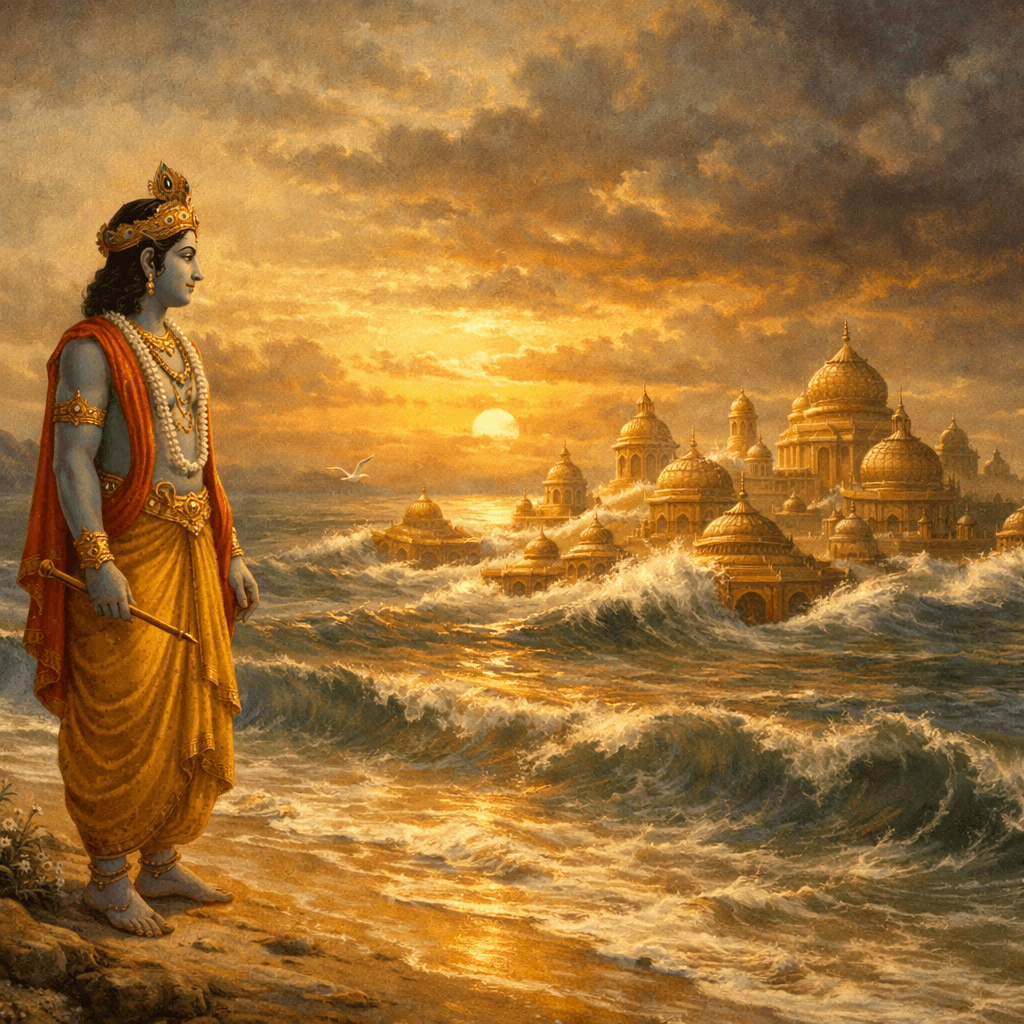
Being the final moments, due to the curse of Gandhari, Krishna and Balarama thought of a pilgrimage to the beach with his people and to have a sea water bath for Moksha. Vajra, being very young, relaxed and was allowed to remain with Vasudeva. The migrated Yadavas were living as sincere devotees of Krishna. Samba had carried with him the Syamanthaka Mani.
What did Balarama order before leaving Dwaraka for penance?
Before leaving Dwaraka for penance, Balarama warned that alcohol would cause their end. Balarama issued an ordinance not to drink alcohol to the people in Dwaraka.
Why did Dwaraka island submerge under the sea water?
Dwaraka island drowned under the sea water due to natural and geographical changes. There was not a particular reason for the submergence of this island, but only natural, to keep the balance of the Earth, and marked the end of the Dwapara yuga. It was a geographical phenomenon, known to Krishna.
What happened to the sincere devotees of the Yadava lineages of Krishna?
The Yadava lineages were the sincere devotees of Krishna. After their life period, they died since death could not be avoided by anybody, but the Yadava lineage continued. Some of the Yadavas had shifted their residences to Puri, Mysore and other zones. During the drowning of the Dwaraka island, Krishna was not in the Palace. Krishna had gone to the forests in the mainland for his final penance.
What happened to the pleasure-loving Vrishni lineages of Balarama?
The Vrishni lineages were related to Ugrasena, Devaki or Vasudeva. Vasudeva was the father of Krishna. Except for Padyumna, all the children of Krishna were pleasure-loving. They liked Balarama and preferred him. After their life period, they died since death could not be avoided by anybody, and the Vrishni lineage fully vanished due to the curse of Gandhari.
All the sixteen thousand wives of Krishna, along with other ladies, were proposed a journey to Indraprastha escorted by Arjuna and Vajra. Some of their children who were living on the Dwaraka island had drowned at sea along with the island.
During the drowning of the Dwaraka island, Balarama was not in the Palace since he had already accomplished the purpose of his life. Balarama had gone to the forests in the mainland for his final penance.
What happened to Kritavarma finally?
Kritavarma belonged to the Vrishni lineage, and under the influence of the curse of the Rishis, he took alcohol as a fighting soldier and tried to fight with others. Before the drowning of Dwaraka island, since there were no weapons, he used the raw sticks on the beach and started to hit others. He was similarly hit by others. The sticks were called as Mausala, and finally, he was killed by Satyaki.
What happened to Satyaki finally?
Satyaki belonged to the Yadava lineage, and under the influence of the curse of Gandhari, he also took alcohol, and as a fighting soldier, he tried to fight with others. Before the drowning of Dwaraka island, since there were no weapons, he used the raw sticks on the beach and started to hit others. He was similarly hit by others. Using the Mausala sticks, he killed Kritavarma, but then he was also killed by others.
What happened to Yadu’s lineage and why?
Yadu’s lineage was related to Nandagopa of Vrindavan, and during the Yoga Samadhi of Krishna, some of his sincere devotees had dispersed to various other places like Puri and Mysore. Gandhari had cursed Krishna’s Vrishni lineage, since his commandos Kritavarma and Satyaki fought on opposite sides, and all the hundred Kauravas, the children of Gandhari, were killed.
Some Yadu lineage people had later built the temple at Puri for Krishna. Later, idols for Balabhadra and Subhadra were also installed in Puri. Since the island Dwaraka had drowned, Vyasa had agreed that Puri was equivalent to Dwaraka in holiness, for the pilgrimage purpose, for the visitors. Yadu lineage means Yadavas, and some of them were present elsewhere in the world. Samba had constructed the Konark Sun temple.
What were the two curses that caused the perishing of the Andhakas and the Vrishni lineages at the end of Dwapara Yuga?
The first one was the curse of Gandhari. The second one was the curse of a group of Rishis. Krishna was neutral towards curses or blessings, but he could postpone their effective timings according to his convenience.
At the end of Dwapara yuga, due to the above two curses, except his father Vasudeva and the great-grandson Vajra, all other inhabitants of the Dwaraka island had perished in the Mausala attacks.
Krishna and Balarama had gone for penance. Vasudeva had naturally expired after the visit of Arjuna. Vajra, with some ladies, had migrated to Indraprastha, being escorted by Arjuna. The Dwaraka island had submerged under the sea. The Vrishni and Andhaka lineages fully perished.
What happened to Balarama finally?
Balarama was the incarnation of Adishesha (the serpent bed for Vishnu). Balarama had gone to the forest for penance near the seashore. Finally, by penance, in the Yoga Samadhi, he got Moksha.
After a few days, his soul entered the seawater as a serpent. Arjuna had visited that place and conducted his funeral rituals. He had returned to Nagaloka and had become as Adishesha again, being the bed for Vishnu.
Why did the Rishi people curse, and why did Krishna accept the curse?
A group of Rishi people, consisting of Vishwamitra, Kanva, Narada and Gargya, with some other monks, had visited Dwaraka, but instead of worshipping them, the Vrishni and Andhaka princes tried to make fun of them, including testing their knowledge.
Krishna had already told his son, Pradyumna, to worship Brahmin people by inviting them, to honour suitably in the Palace, in order to get their blessings, after being satisfied there. These facts are already described in the Danadharma Parva on this website.
Due to mass amusements, some of the children of Krishna had played tricks. They dressed one of the Vrishni clan youth like a pregnant lady and presented him before the group of Rishi people. The youth asked collectively with them which child would be born by the dressed pregnant lady.
The group of Rishi people, with their unmistakable knowledge, could immediately understand their collective mischievous actions and cursed them that the born would eliminate their lineages.
They reported their mistakes to Krishna. Krishna accepted the curse. When the dress was removed from the body of the fancy-dressed youth, the cast-iron piece of rod used by them had fallen down.
Later, they had rubbed the rod on some granite stones on the seaside to make it smaller, and when it was very small, like a nail, they had thrown it into the sea. That nail piece was swallowed by a fish; later, the fish was caught by a hunter called Jara.
Jara used the nail as the sharp head for an arrow and kept it in his quiver for hunting purposes later. The powdered hard iron-like rod portions and particles had been absorbed by strong aquatic plants, referred to as Mausala in Sanskrit. Krishna knew the items regarding the curse of the Rishi people and accepted it for later use. He could postpone the results of the two curses and had suitably utilised them.
What did Krishna tell his father, Vasudeva, before leaving Dwaraka, finally?
इमांचनगरींसद्यःप्रतियातेधनंजये।
प्राकाराट्टालकोपेतांसमुद्रःप्लावयिष्यति॥
Krishna told his father, Vasudeva, about the instructions of Arjuna related to Dwaraka. Krishna told that after the return of Arjuna from this city (Dwaraka), the sea water would cover the entire fort and Palace. The island would be drowned, but before that, Arjuna would come here from Hastinavati, and he would carry him along with his great-grandson Vajra and the ladies of the Dwaraka city to Indraprastha. Krishna had sent Daruka to Hastinavati to bring Arjuna there.
What happened to Krishna finally?
Krishna was the incarnation of Mahavishnu (the God of protection or Vishnu). He had walked in the forests and sat, putting his right leg over his own left lap, under a tree for penance in the evening. The hunter, Jara, was in that forest, but he could not get anything on that day and, from a distance, found something like a deer under the tree, finally that evening.
He aimed his preserved arrow at it and came near the tree. Krishna, after being hit with that arrow by that hunter to his right foot, during his Yoga Samadhi, had ended his life as Krishnavatara was over. Krishna had lived without any wounds during the Mahabharata war due to the blessings of Durvasa Rishi. Regarding the blessings of Durvasa, details are given on this website under the Danadharma parva.
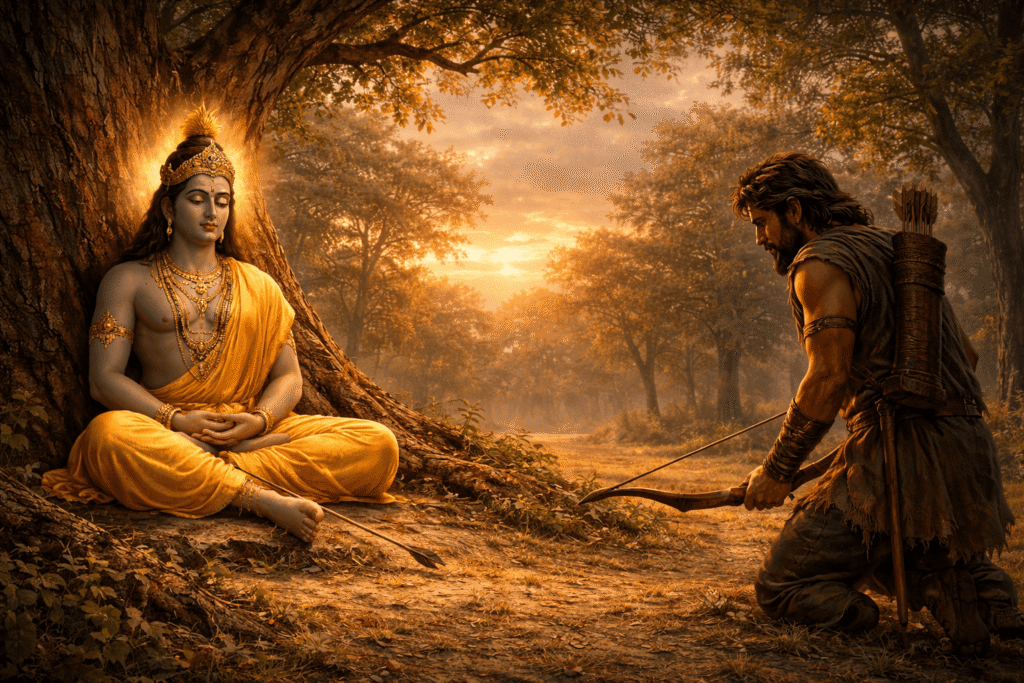
Krishna had to end his life, with the hitting of the above-mentioned arrow called as Mausala, wounded, due to the curse of the Rishi people. Before leaving Dwaraka, Krishna had arranged for the comfortable journey of Vajra to Indraprastha. He had sent a message to install Vajra as the king of Indraprastha. The soul of Krishna had amalgamated with the universal energy as Paramatma.
Later, Arjuna visited that place and conducted his funeral rituals. Krishna had returned to Vishnuloka. He had become the protector again, being God Vishnu.
What had Arjuna done for Krishna, Balarama and Vasudeva?
Arjuna had arranged for the final funeral rituals in respect of Krishna, Balarama and Vasudeva. Then Satyaki and Kritavarma were alive, who helped Arjuna.
What happened to most of the Vrishni, Andhaka ladies on the way and why?
Most of the Vrishni, Andhaka and Yadava ladies were captured by the burglars when they were moving on the river banks of the five river banks area. The attack was to seize gold, silver, gems and jewellery. Arjuna was helpless, and he could not protect them as there was no Krishna then. Further, he escaped with a few ladies and Vajra.
They reached Indraprastha. There was no Vrishni and Andhaka lady. The reason was attributed to the curses of Gandhari and the Rishi people. Arjuna was very sorry and, after accommodating them in Indraprastha, visited Vyasa and pleaded his grievances. Vyasa explained to Arjuna about the Mausala and curses.
How had Arjuna accommodated the son of Kritavarma and Satyaki?
The son of Kritavarma was accommodated at Marthikavata along with the ladies of King Boja by Arjuna. The son of Satyaki, Youdhana by name, was accommodated on the banks of the Saraswathi River along with the ladies. They were unaffected by the curse of Gandhari and the Rishi people, being the sincere devotees of Krishna, and during the lifetime of Krishna, Kritavarma and Satyaki had sincerely served him.
What did Uddhava do?
Uddhava was a sincere and friendly devotee of Krishna. After Krishna had moved to the forest for his final penance, Uddhava tried to search for him in the forests to see him and speak with him.
Being hit by the arrow of Jara, Krishna could not respond to Uddhava. Uddhava reported to Arjuna about the facts he found in the forests. Arjuna had arranged for the final funeral rituals in respect of Krishna.
What happened to Vasudeva, the father of Krishna, in the Dwaraka palace?
Vasudeva had pleaded with Arjuna about the facts he had heard about Krishna and Balarama that happened in the forests, and expressed his grievances. Arjuna had consoled Vasudeva and arranged for the final funeral rituals in respect of Balarama also.
Arjuna told Vasudeva to be prepared to go to Indraprastha. But due to old age, he liked to conduct penance inside the Dwaraka palace. On the following day, Vasudeva also ended his life through Yoga Samadhi. Arjuna had arranged for the final funeral rituals of Vasudeva there. Arjuna had consoled the grieved people.
Who was installed at Indraprastha after Dwaraka submerged under the sea?
Vajra, the great-grandson of Krishna, was installed on the throne of Indraprastha. It was arranged by Arjuna as per the instructions of Krishna and other senior people.
Was there any Indian cow on the Dwaraka Island?
Yes. There were some cow herds on Dwaraka island. But the grass was not abundant there. A few years back, Krishna and Balarama had shifted their Palace people during the night, due to the frequent disturbances from Jarasandha, but they did not carry many cows with them to Dwaraka.
Indian cows were available in the mainland region, and daily milk and milk products were arranged for the palace of Balarama, supplied from the mainland. Before drowning, the island cow herds were shifted from there by the migrating Yadavas. Krishna was their protector.
After the Mahabharata war, for how many years did Krishna and Balarama live?
After the Mahabharata war, Krishna and Balarama had lived for thirty-six years.
How did Krishna manifest his divine powers in this world like God Rama?
Rama had manifested his divine powers in three forms. The first one was in the chanting of his name as ‘Rama’ with devotion. The second one was in his idol, ‘Rama’, to be worshipped. It could be with or without Sita, Lakshmana and/or Hanuman, but with devotion. The third one is the Ramayana as his history to be read or heard.
Rama was the incarnation of God in the Treta Yuga, but his powerful divine energy would always be permanently manifested in this world, protecting his believers.
Krishna also manifested his divine powers in three forms. The first one was within the living Indian cow, as a hidden part of his energy, worthy to be treated with devotion.
The second was in the Shrimad Bhagavata Maha Purana story book, being the powerful energy form as his biography. The third one was the idol of Krishna, simply to remember as a powerful idea of his human form as ‘Yogeshwara’ to visualise with the Gita advising Arjuna, referred to as ‘Yoga’. He was the incarnation of God for all time. He is the protector of his believers.
Why does Vyasa praise the Bhagavata Purana?
Vyasa praises the Bhagavata Purana since Krishna always resides in that book, and Krishna supported non-violence. Devotion is the main theme in this book.
How did Vyasa praise the Bhagavad-gita, including Krishna and Arjuna?
यत्रयोगीश्वरःकृष्णोयत्रपार्थोधनुर्धरः।
तत्रश्रीर्विजयोभूतिर्ध्रुवानीतिर्मतिर्मम॥
The above verse is described on this website, under the Bhagavad-gita parva of the Mahabharata, at the end of the advice of Krishna to Arjuna. Vyasa had written that life would be peaceful and happy if led with legally allowed methods, by the devotion of Krishna, as told to Arjuna by him, as described in the above verse.
Next post, Mahabharat: Ahaprasthanika Parva would be more interesting.
Mahabharat: Swargarohana Parva would be presented in another article.
What are the benefits of reading this story?
On reading this story, children would gain more memory power, great moral strength in their lives in future; creating a sense of self-reliance, leading to peace and progress.
It is humbly prayed for the blessings of God Krishna upon us.
Readers may share this story with children, friends and family.
Leave a Reply