
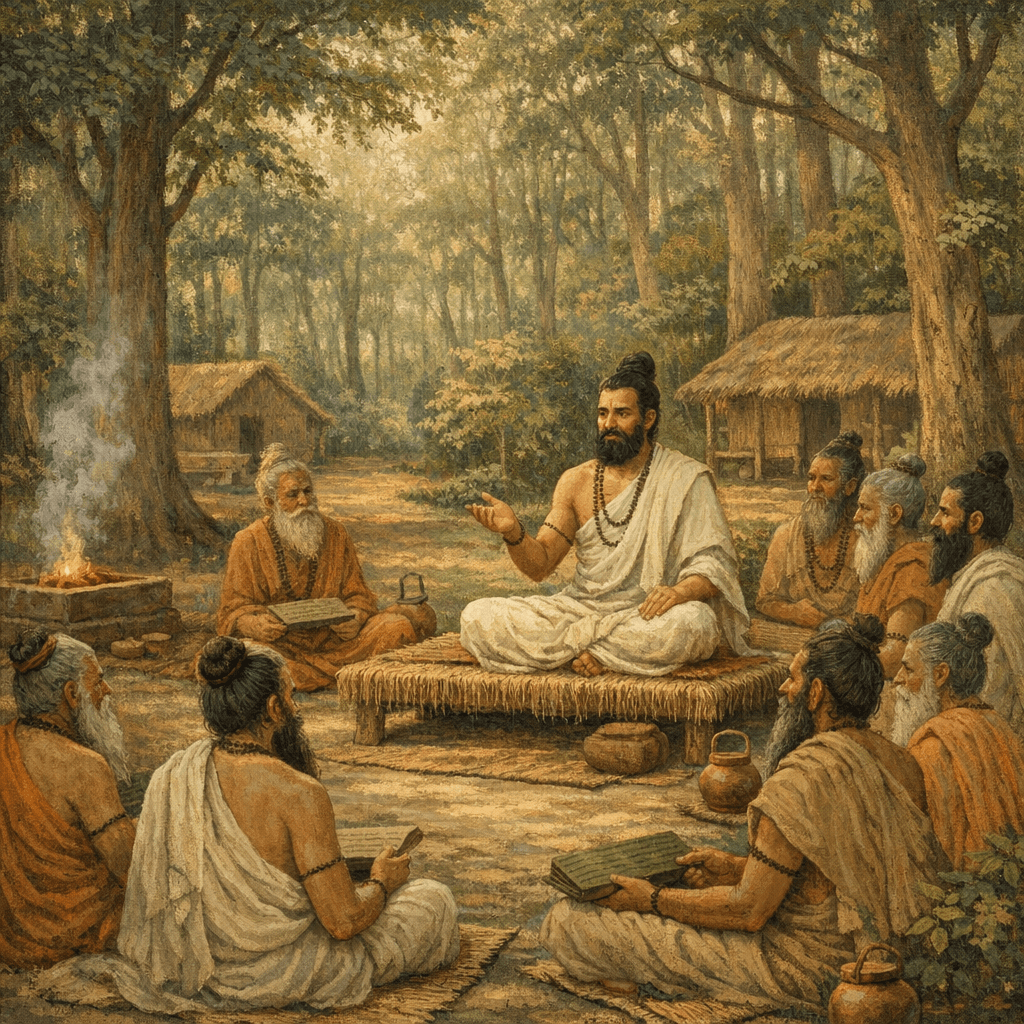
Harivamsha Purana Khila is the ninety-ninth Upa Parva included as a single Maha Parva at the end of the Mahabharata. Vedavyasa Maharshi had taught all the Puranas to his disciples. Vaishampayana continued narration to Janamejaya in reply to his queries at the Sarpa satra site of Takshashila. Later, King Janamejaya returned to Hastinavathi after the full completion of the ceremonies.
Ugrashrava was the son of Lomaharshana Rishi. He returned to Naimisharanya with his father, and he later conducted a Mahabharata satra there. After the end of the Mahabharata in that satra, the Harivamsha Purana was described in detail. Initially, he had heard it at Takshashila with his father. Generally, they were recognised as Suta Puranikas.
Why was Takshashila selected as the yaga venue for the Sarpa Yaga?
There were two main reasons for selecting Takshashila as the site for the serpent yaga. The initial one was the serpent Takshaka, and his species were abundant in Takshashila. Janamejaya desired to reduce the number of serpent species. The second reason was also genuine. Due to the flood, the palace buildings at Hastinavati were dilapidated, not suitable in strength, and the halls were damaged, raising questions about the safety and security of the lives of guests and audience.
During the period of Sarpa Yaga, the Hastinavati palace buildings were being renovated. The copies of the Mahabharata volumes were preserved in the various Palace libraries due to various reasons. Esteemed readers are requested to browse ‘Astika Parva’.
What was the role of Astika in the Mahabharata?
Astika had cleverly stopped the violence in the serpent yaga of Janamejaya. More details of the curse of Kadru would be seen in the Astika Parva. Jaratkaru was the mother of Astika, and Kadru was his grandmother. The number of species of serpents in nature was controlled by him. Snake Adishesha was Balarama in his rebirth.
Why is telling a special history with the name Harivamshapurana necessary?
Khila means appendix to the main Mahabharata pages. Later in the assembly of the Rishi people in the court of Shatanika, the king desired to hear a new Purana. It was the Harivamsha Purana. India had been ruled by many kings and was subject to their will and orders. Hence, the Harivamsha Purana had been suitably edited to please the ruling kings from time to time.
With the permission of Vyasa, his disciple Sumantu had told the Harivamsha Purana. Samba was the son of Krishna, and Hari means God Vishnu; thus, in the lineage of Hari, Samba was the surviving son. The Vrishni and Andhaka branches of the lineages have been abolished, but the Yadavas continued. Several editions of this Purana were available with different side stories.
How did Samba survive the drowning of Dwaraka island?
Krishna had informed in advance about the drowning of Dwaraka island. Hence, the glittering Syamanthaka diamond was handed over to Samba, and his family had migrated with a few cow herds to the mainland. Samba had constructed the Sun temples at Konark and at many other places. So, Samba survived with his son.
What was the wedding story of Samba?
Jambavati had grown up in the orphanage of the old bear, Jambava. Later, Krishna married her with the Syamanthaka diamond. So she did not belong to either the Vrishni or Andhaka lineages. After many years of her marriage, no child was born to her.
Krishna had many children in Dwaraka. Jambavati desired to have a child, and she was observing many fasts, worshipping God for many years. Finally, Jambavati prayed to Krishna to have one child. Then, Krishna conducted penance, worshipping God Shiva with Parvati. All other children of Krishna had grown up then.
Finally, Shiva appeared with his wife Parvati, before Krishna and asked for his desired boon. Along with Parvati, Shiva was addressed in Sanskrit as ‘Samba Sadashiva”. Krishna told that he desired one child similar to him. Jambavati then got the child, and he was assigned the name Samba, just to remember ‘Samba Sadashiva’.
By that time, other children had grown up and later became involved in the curse of a group of Rishi people in Dwaraka. Samba was a small child then, but able to walk. He could not talk. So he was away from the curses of the Gandharai and the Rishi people. He had not participated in the war.
After his education, Samba had searched for a job and reached the Hastinavati Palace. There he met with Lakshmanaa, the daughter of Duryodhana. The Swayamvara date of Lakshmanaa was fixed then, and she invited him to the Swayamvara function. Lakshmanaa had liked him for her marriage, and she desired to avoid the Swayamvara function.
So, on the day of Swayamvara, Samba abducted her, but the security soldiers of Bhishma were very strong and prosecuted him, and put him in jail with Lakshmanaa. The news had reached Krishna, but he had not responded to it. Balarama was the king of Dwaraka, and the report of the imprisonment of Samba was presented before Balarama.
Balarama was the teacher of Duryodhana in the mace fighting arts. Balarama was very fond of Samba, being the youngest, visited Hastinavati with his yoke on his shoulder and ordered Duryodhana to release Samba with Lakshmanaa. Duryodhana was silent. Then, Balarama broke the walls of the jail and released Samba with Lakshmanaa. Samba had escorted Lakshmanaa safely to Dwaraka, and their marriage was conducted there.
Later, Duryodhana and the people of the Hastinavati palace felt happy to hear about the wedding of Samba and Lakshmanaa. After the war, Samba was living in the eastern coastal areas of the Indian sub-continent happily with his Yadava family. Frequently, he visited the Dwaraka Palace and his parents.
The Jain kings had influenced the Sanskrit literature, and hence this Khila Harivamsha Purana, was also retold to satisfy the Jain kings. The re-writers tried to satisfy the rulers, and hence the latest Harivamsha Purana had evolved in Sanskrit. Before publishing the real consolidated book, several verses from it would have been deleted from the available manuscripts, which contradict the opinions of the rulers. Pleasing new verses might have been inserted to increase the aesthetics.
The optimised version of the Harivamsha Purana was frequently published. The main purpose of the publishers was to uphold the principles of Sanatana Dharma in India. Since Sanatana Dharma has an inherent property of sustainability in any situation, the publishers were showing a soft approach to rulers’ opinions.
Similar to Shreemad Bhagavata Mahapurana, the main content of the Harivamsha Purana was the life stories of incarnations of Shree Hari. Similar to the Ekadashi day in the lunar calendar, the night period was termed as Harivasara for the devotees to worship Shree Hari, as God. Veda Vyasa Rishi had written all the Puranas. It was recommended to read the Shreemad Bhagavata Mahapurana. Harivamsha Purana, being the later edition in the series of Puranas, could be tried if time and resources permit.
How was the Harivamsha Purana published?
Harivamsha Purana was published in Sanskrit during the Jain ruling Era. Some Gurukul teachers were granted scholarships, and they carefully tried to keep the Jain style of predominance in the verses and tried to publish a pleasing book. The scholars within India and outside India engaged in debate about various contents of this book, time and again evolving the latest volumes. Hence, the ideologies of the Jain religion also penetrated into this book.
Time is always a precious item. The main purpose of rulers was to enforce peace in society. Security for life for all was assured. Some people are still present in India with the oral ability to recite one of the branches of the Vedas if security of life is assured.
It is certainly better to worship ‘Hari’ by hearing or reading Shreemad Bhagavatha Mahapurana. Reading any chapter could render virtues in life. Regarding the Syamanthaka diamond, more descriptions were published on this website, in the articles Draupadi Satyabhama Parva and Sanathsujatha Parva. Esteemed readers are kindly requested to browse these articles. Hard set copy of Harivamshapurana is available in several volumes of edited books.
Next post, Khila Bhavishya Purana would be more interesting.
‘Annaprashana and Vidyarambha’ would be presented separately in another article.
What are the benefits of reading this story?
On reading this story, children would gain more memory power, great moral strength in their lives in future; creating a sense of self-reliance, leading to peace and progress.
It is humbly prayed for the blessings of God Krishna upon us.
Readers may share this story with children, friends and family.
0 Comments
1 Pingback