
Mokshadharma Parva is the eighty eighth Upa parva included in the twelfth Maha parva named as Shanthi parva. Vaishampayana continued narration to Janamejaya in reply to his queries as follows.
What was Manki Muni Gita, told by Bhishma to Yudhishtira?
Manki Muni Gita is a side story told by Bhishma to Yudhishthira. There are three main characters in this story. The moral lessons are: the desire to acquire more money, the need to be deserving of that wealth, and the importance of having God’s blessings for it.
King Janaka, while tilling the land with a plough and yoke using two grown-up male calves, found a box containing the child Sita. The news spread quickly, and people began speaking of Janaka as a very fortunate king.
Manki Muni was a greedy man. He wanted to be rich and earn more money. He thought that if he also tilled the land with a plough and yoke, he too could become rich one day. He managed to get two grown-up male calves. Wanting to learn how to till, he put the yoke on the shoulders of the two bulls, tied the plough, and began walking over a very large, level field. The bulls were small but moved very quickly, and Manki Muni could not keep up with their speed.
At some distance, a big camel was resting, lying on the field. The two uncontrolled bulls tried to pass on either side of the camel while still joined by the yoke. When the yoke touched the camel’s shoulders, it was disturbed, stood up, and started to walk quickly. The two bulls were hanging on either side of the camel and, because their necks were tied to the yoke, both died after a few minutes from suffocation.
King Janaka was very happy in his palace, but Manki Muni was very sad in his field. He was inexperienced in his new trade and felt unlucky. Previously, he had forgotten God, but when he failed, he immediately remembered God. Bhishma told Yudhishthira that the third character in the story was God, and that Manki Muni learned the moral lessons.
Manki Muni abandoned his greedy desire for more money and performed penance. He became a devotee of God and led a simple life. Later he attained peace and became a rich man. He remained a Muni, not a Rishi.
In the Moksha Dharma Upaparva of the Shanti Parva of the Mahabharata, a few Sanskrit verses describing this side story are known as the Manki Muni Gita.
What were the ‘Acharas’ leading to Moksha as mentioned by Bhishma?
The holy codes of conduct could be referred to as ‘Acharas’. The life under Sanatana Dharma included some actions mentioned by Bhishma for our information. The teacher should be saluted and offered a seat. Use the right hand for holy works. Observe the codes of Sanatana Dharma for a happy life now as well as for life after death. Never feel shy to observe them. Money and death are different. Try to avoid sinful works. Vegetarian food is always appreciated. The angels are always noting our works. Try to encourage virtuous works. Address the elders with reverence. Try to be neat and clean. Moksha happens only after death.
सूर्यं सदोपतिष्ठेत न स्वप्याद्भास्करोदये ।
सायं प्रातर्जन्संध्यां तिष्ठेत्पूर्वां तथापरां ॥
Rise before sunrise. Do not sleep during the time of sunrise and sunset. Do the morning and evening prayers daily. Dedicate the works to God. But Bhishma said sleeping in the afternoon after food and sleeping at midnight are allowed.
What did Bhishma tell about hands and feet with respect to food and sleep?
Bhishma told not to rise with wet hands after taking food and not to sleep with wet feet. One should wash the hands after food and then dry the hands with a dry towel. The period of life was one hundred and twenty years, and cleanliness was the secret.
Why did Bhishma tell the side story of Jajali and Tuladara to Yudhishtira?
Bhishma told the side story of Jajali and Tuladara to Yudhishtira to illustrate the simplicity of Sanatana Dharma. Jajali was a Brahmin engaged in penance. He had accomplished the hard and most difficult parts of penance and acquired the ability to move around the world at his will and desire. He could live on land and in air and still continued his penance to upgrade his holy capacities. He could understand the languages of all living creatures of this world, including birds and aquatic beings. Later he started doing his penance under the deep seawater for many days. Jajali then thought his capacities were unique to him alone, being the highest and recordable as unbeatable by anybody in this world.
When he was conducting his penance under deep seawater, he heard the aquatic animals speaking lightly about him to one another and making fun of him. Due to the power of penance he was also able to communicate with them. He asked them who would be able to overtake his records in this world in penance. Then they laughed and told him his grade would not come near the value of Tuladara, the merchant of Varanasi. Jajali was advised by them to meet Tuladara to get more guidance, by approaching him directly. Then Jajali started to doubt his own abilities and started to go near Tuladara at Varanasi. On his way also he was doing penance.
In a dense forest he stood still and conducted his penance. Rain fell, but he stood still. In the wind and sunshine also, he remained stable there. A bird thought to take benefit of his still head and tried to build its nest over his head. Jajali did not disturb the bird but felt proud to bear it while standing and continued his penance. Of course, he gained his divine power more and more. The bird safely deposited its eggs in the same nest over his head and later its young ones grew older and learned to fly in the sky. Initially, the birds were returning to the nest, after their food, in the evening, before sunset. Jajali was thinking proudly about his generosity as well as his penance and divine capacities.
After a few months, one day, the birds shifted to another forest, so they never returned. In search of food, birds were flying over his head, but they were different birds. Jajali confirmed that the earlier birds had shifted, went to a nearby river, and had a good bath, cleaning his head and body. Due to his high power of penance, as soon as he thought of Tuladara and desired to visit him, he found himself in Varanasi, standing before the shop of Tuladara. Jajali felt very proud of his own capacity in penance.
But to his surprise he was greeted by Tuladara as if he had been waiting for a customer at his shop. Tuladara was a merchant, and a few customers were collecting their commodities from him. Tuladara requested Jajali to sit there and sought permission to dispose of his earlier customers. Jajali permitted and sat there waiting patiently. Tuladara, after sending away all his customers, started speaking to Jajali. Tuladara told him about his penance under deep seawater and about the birds born over his head. Then Jajali was surprised to hear these words from the mouth of Tuladara.
Finally, Tuladara told Jajali that after gaining divine powers by penance, the person should practice humbleness. The Rishi should not be egoistic. Tuladara explained that as he was living as a merchant in Varanasi, he would continue his business as usual in future times also, but he would like to get Moksha after death. Then the birds born on Jajali’s head were found flying in the sky, and both Tuladara and Jajali could recognize them. Jajali requested him to teach more powerful techniques to become a greater Rishi. Then Tuladara advised Jajali to live with humbleness while leading a peaceful life and, for further teachings, to call the flying birds his children, since they had been born on his head with his kindness and they would teach him.
When Jajali called the birds, they came near him and thanked him for his kindness. The birds explained to him that he had already started leading life on the right path, but he had unnecessarily or unknowingly moved down into the deep seawater some time back to gain more power with ambitious desires. To achieve Moksha such magical powers were not required for human beings. The path of penance was rightly selected by him, but he should avoid proud egotism and over-ambitious desires. Then the birds thanked Jajali and flew away.
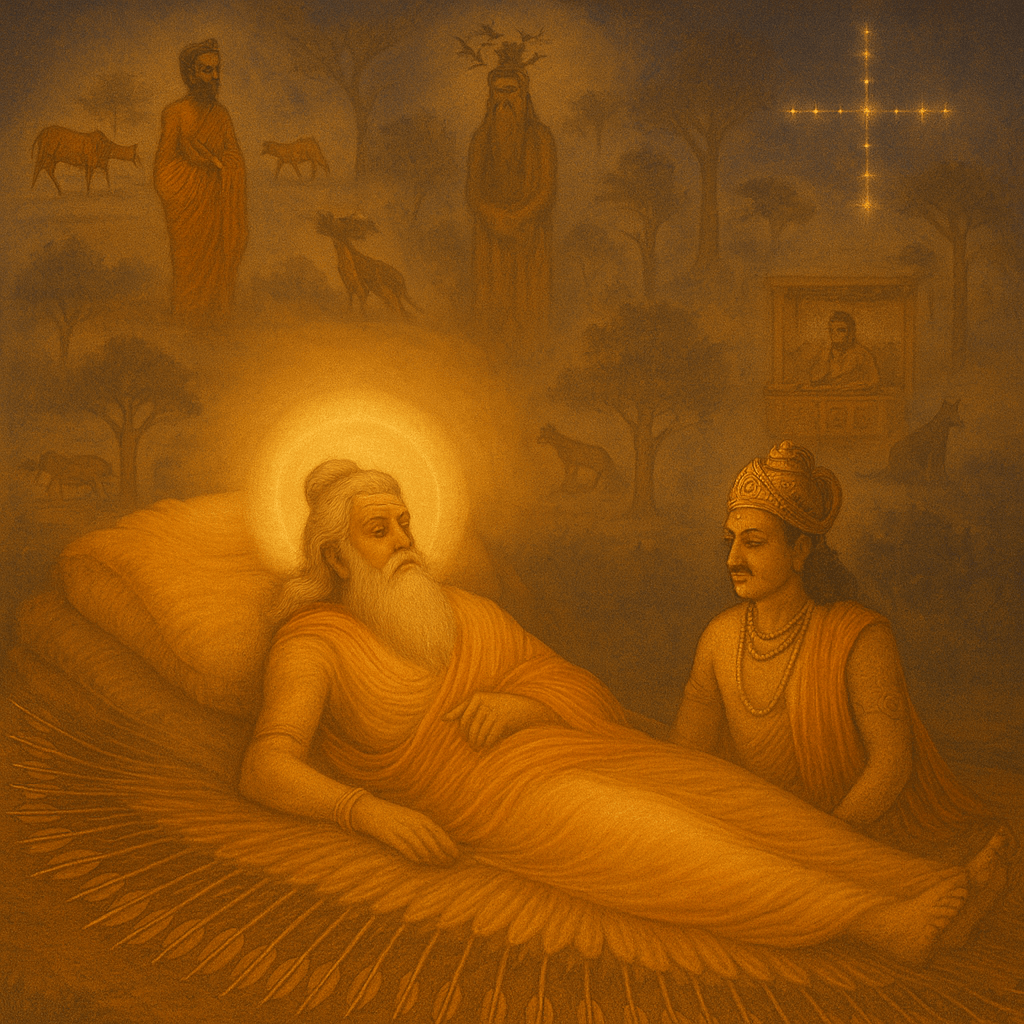
Jajali thanked Tuladara for his good Sanatana Dharma teachings and, after visiting God Vishwanatha at Varanasi, led a normal life there, teaching others. Bhishma visited Jajali and got the skill to endure pains by practicing yoga. Therefore Bhishma had been lying on the battlefield without experiencing any kind of pain until his Moksha. Yudhishtira humbly heard it.
How was Moksha explained in the conversation between a father and son?
The son reminded his father about death in their conversation. Bhishma told that the son had advised his father to follow the path of yoga in all works, similar to the message of Krishna in the Bhagavadgita. The son told his father not to postpone any work, since death is chasing living beings. Hence the schedule of tomorrow should be finished today, and the schedule of evening should be finished in the morning.
Usually parents are found advising their children, but here the case was reversed. The son and father were not named by Bhishma, but it could be confirmed that the father was not learned but the son was just educated, having returned from his teacher. Both of them were confident about Moksha and happy to face death at any time.
How did Bhishma explain the life that deserves Moksha?
Doing works with yoga, as in the Gita, makes life deserving of Moksha.
What was the side story of the fox and Kashyapa Rishi?
Kashyapa Rishi was travelling, sitting on the chariot of a merchant. When the chariot was passing through a dense forest, the merchant found the Rishi to be a financially poor man and abandoned him in the forest. Then the merchant in his chariot went to his next desired city for selling his commodities. In the forest, Kashyapa Rishi felt desperate and desired death. Then a fox tried to teach him about the holiness of human life.
Indra had taken birth as a man first but next in this world took birth in the form of a fox. The fox started to praise Kashyapa Rishi for possessing two hands. The fox told the truth, that he had been a man in his previous birth but had lived as an atheist and hence became a fox in the current life. The fox praised Kashyapa since he could do Yajna, give donations, and conduct penance. The fox also said that Kashyapa could attain Moksha, but being a fox, he could not achieve such a high status after death.
After hearing all these words, Kashyapa started to doubt the fox and simply looked at him. He was financially poor but very rich in his virtues. His virtues influenced the fox to show himself as the original Indra, and then Kashyapa decided to live life as a human being, facing the challenges and acting as directed by Indra. Ultimately, Kashyapa Rishi became one of the Saptarshis in the sky, so Kashyapa got a star position. Thus, Bhishma told Yudhishtira about the side story of the fox and Kashyapa Rishi.
What were the opinions on Varnashrama of Bhrigu and Bharadwaja?
The opinions of Bhrigu and Bharadwaja on Varnashrama were told by Bhishma to Yudhishtira as he had heard from them. Brahma prepared his principles first and then created accordingly the sky, earth, water, air, and fire. Human beings could not measure them accurately with their limited knowledge. Brahma created the seeds borne on the trees together, abiding by their principles. Those principles were called the laws of nature.
Initially, Brahma created many living species. Finally he created the human species, all as Brahmins. Then earth was in a global size, the soil portion being similar to a lotus flower, water floating around it, and Saraswathi sitting on it with Brahma. White color was prominent then. Brahmins later faced many challenges, found wounds over their bodies, and saw red color.
Protection was the next principle; hence Saraswathi was insufficient, and Vishnu, an additional God, was required. Then, in addition to the lotus, mace, wheel, and conch became necessary for Vishnu, and red was the second color.
Protection was the second principle. With the red color, some human beings aligned with their aptitude, and protection was practiced by them. They were called Kshatriyas. So Kshatriyas were born with red color. From a great distance the yellow color was visible to anybody.
A few human beings engaged in the collection of goods and their distribution, also competing with one another but compromising with Kshatriyas as well as with Brahmins, were grouped as Vaishyas. Vaishya people liked yellow color. Some Brahmins desired to enjoy life by eating fish, eggs, and meat of animals. The dried substances were black in color.
The fourth category of people liked any fourth color other than white, red, or yellow. The fourth color was associated with Suta, and they were very helpful to the general human society. The fourth category people, Sutas, were called for help by the other three categories of people since their endurance with nature and weight-lifting capacity was comparatively high. So they were later recognized as service providers.
In Sanskrit, color was termed as Varna, and these four categories were termed as Varnashrama. Death was an unavoidable principle, and God Shiva had been associated with it. Generation was attributed to Brahma. Protection was attributed to Vishnu. Destruction was attributed to Shiva. But Varnashrama, found in human society, was not related to Moksha. All human beings of all four Varnas were eligible for Moksha, which was not decided by Varna but by their completed virtuous works during their life period. With wide characters and completed works, the doors of Moksha open.
How did Bhishma explain the Adhyatma principle with respect to Moksha?
The life inside the body is called Jeevatma. It is a part of the supreme soul called Paramatma. The knowledge is the power for human beings. The science of the soul involving body, sins, virtues, and rebirth or Moksha is termed Adhyatma.
What was the side story of Japaka?
The side story of Japaka was not any story but a philosophical description about the result for a person doing Japa and its divinity. One article on Japayajna is already available in this website and esteemed readers can browse the same for details.
What was Disha Swasthika?
Disha means direction in Sanskrit. In the north direction there was a group of seven stars below the pole star (Dhruva), called the Saptarshis. In the south, one star was mapped to Agasthya. Similarly, for east and west, a few stars (twenty-seven groups of stars) were mapped to recognize and remember a few past Rishis. This system of referring Rishi people mapped to stars was called Disha Swasthika by Bhishma to Yudhishtira. The three stars in a line remind Karthikeya, and a group of one hundred stars (Shatabhisha) reminds about Rishi Vasishta under Disha Swasthika.
What was Shreesannidhana?
Good character was depicted as Shreesannidhana. It was manifested in four parts: the first in earth, the second in water, the third in fire, and the fourth distributed among persons possessing truthfulness. Wealth was the secret.
What did Ugrasena tell?
The grandfather of Krishna, the father of Kamsa and Devaki, was Ugrasena, and after killing Kamsa, Krishna again crowned Ugrasena as the king of Mathura. Krishna asked about the best person to be worshipped, and in reply Ugrasena told him that Narada was the best person deserving worship. The good characters of Narada were appreciated by Ugrasena along with his good actions.
What did Vyasa tell Shuka Rishi about Mokshadharma?
The creation of this universe and the duties of a good person to achieve Moksha were described by Vyasa to his son Shuka. Bhishma explained it to Yudhishtira.
What were the main features of Dharma?
The main features of Dharma were classified into four. The first part was called Veda, and it was always permanent in this world, recognized as Shruthi. The second was called Smrithi, and it was changing in this world as per the will and desires of the rulers, recognized as constitutionally approved laws. The third was called Truthfulness, and it was changing in this world as per the need of place and time as decided by the rulers, recognized as law and order. The fourth was called the group of Learned People or Scientists, and it was changing in this world as per the conveniences of the rulers, recognized as the science of the societies.
All actions depend on the character of the person. Bhishma said Ravana had done penance and got huge powers, but he was condemned by the majority of the people. Vibhishana had pleased Rama and become a Chiranjivi; he was liked by the majority of the people. So Dharma could be appreciated as good practices. Demons were against Sanatana Dharma, but angels supported it.
Why was Yajna condemned by Bhishma and when?
Yajna was condemned when violence was involved in it, Bhishma told.
अहिंसा सकलो धर्मो हिंसा यज्ञे ऽसमाहिता ।
सत्यं ते ऽहं प्रवक्ष्यामि यो धर्मः सत्यवादिनां ॥
Observing non-violence was preferable to all kinds of Yajnas. Truthful people should follow Dharma-supported Yajna without offering animal meat to the fire. Bhishma told Yudhishtira that Yajna should be conducted without any violence.
Bhishma had already conducted three hundred Ashvamedha Yagas to avoid the thought of war by Duryodhana for thirteen years, and details about these are already available in this website under Bhumi Parva. But Bhishma did not do any self-appraisal about them; instead, he told a new history with a few characters.
Sathya was a Brahmin of the Vidarbha kingdom. He desired to conduct Yajna rituals without any animal sacrifice. He knew all Vedic hymns and ordered his wife to participate in it.
He went to the forest, and his wife followed him to avoid his curse. She used clothes made of dead peacock feathers. In the forest, Sathya used domestic grains, cow ghee, and dried wooden logs. His wife helped him. There was a deer in the same forest, but it had been a demon in its previous birth. By sacrificing itself in the Yajna fire, the deer thought it could go to heaven quickly.
The deer approached Sathya and requested him to offer its body in the next day’s Yajna in the fire altar. Sathya became very sympathetic to see the deer and denied its request, considering it his colleague in forest life. Sathya finished his Yajna as usual, following domestic methods on the following day also.
The deer died naturally after a few months and went to heaven due to hearing the hymns recited by Sathya during his Yajna. Initially, people desirous of eating meat or hunters made fun of him, saying that without flesh of animals the angels would not be satisfied by his Yajna. His Yajna fire was called Savithri, and he explained to them the supremacy of vegetarian food, which pleased Savithri.
The public of the Vidarbha kingdom later started to visit his rituals and began offering him various commodities as gifts. Sathya was not interested in the gifts but requested the servants of the king to take the gifts and deposit them in the king’s treasury.
The king sent a chariot to invite him to the palace and to honor him in the court hall, in a session meeting, with valuable items. But he politely denied them all. The king was surprised to see his sacrifices. In the old age of Sathya and his wife, the king arranged for their comfortable living in the same forest.
Finally, with the blessings of Savithri, both were elevated to heaven, but the king arranged their funerals with the help of the palace priest. His Yajna was appreciated by all. The people with their king in the Vidarbha kingdom were living happily.
Bhishma was vegetarian and condemned violence. Bhishma advised Yudhishtira to do Ashvamedha, inviting all, and to honor the king of Vidarbha as the most honorable king and as a guest in the Ashvamedha Yaga, since he was already appreciated by him as a model king. In the Babruvahana Parva, the same details would be available in this website.
What was Parashara Gita told in the Mokshadharma?
The Parashara Gita was a collection of moral lessons or ethics told by Parashara.
What did Yajnavalkya tell Janaka about Mokshadharma?
The five senses and five organs of human beings were provided for working in this world while abiding by Sanatana Dharma. One should gain virtues and try to eliminate sins. Finally, human beings could achieve Moksha; thus it was told.
How was Shuka born and how did he become a famous Rishi?
Similar to Shikhandi and Drishtadyumna, Shuka was also born through the fire rituals by Vyasa Maharshi. King Janaka of Mithila was his primary teacher, but later he studied under his father Vyasa. Shuka was not interested in family life and hence directly started to study the sciences of Moksha. There were already four disciples in the hermitage of Vyasa in the Himalaya. When Shuka started to study the advanced portions of Adhyatma in the Moksha science under Vyasa, the other four disciples requested a boon from Vyasa.
Vyasa agreed and blessed them all. The other four disciples requested Vyasa together that the next sixth disciple blessed by their teacher should not become famous. Then Paila got Rigveda, Vaishampayana got Yajurveda, Jaimini got Samaveda, and Sumanthu got Atharva Veda.
Later, Shreemad Bhagavatha Maha Purana was told to his son Shuka along with the other four disciples. Lomaharshana was the fifth disciple of Vyasa, but he was the sixth in the serial to study under Vyasa, having joined later. Due to the promise given to the initial four disciples, Lomaharshana could not become famous in this world. Later, in Naimisharanya, Lomaharshana propagated all the eighteen Puranas.
Shuka told the Bhagavatha Purana to Pareekshit before his death and hence became famous. The current history was told by Vaishampayana to Janamejaya at Takshashila in the Sarpayaga assembly, after stopping the Yaga. Later, this Mahabharata was called Panchamaveda. Hence there was no sixth Veda with a sixth famous Rishi.
What was the story of Dvaipayana and Narayaniya?
The story of Dvaipayana means the principles of this world as described by Vyasa about Moksha achievements, as told by Bhishma in the above deliberations. The story of Narayaniya in this context means the principles of this world as described by Narada about Moksha achievements, as told by Bhishma with reference to Narayana’s idol with a human body and the head of a horse. This type of idol of Narayana was called Hayagriva. About Hayagriva, a separate article is available in this website, and the esteemed readers are kindly requested to browse it. A devotee of the Hayagriva idol could get Moksha with peace and happiness.
Why did Vyasa say the Bhagavadgita message is preferable to Moksha Dharma?
The principles told in the Bhagavadgita were the opinions of Krishna. The principles told in Mokshadharma were the opinions of Bhishma. Moksha could be attained only after death. During the life period of human beings on this earth, yoga as told in the Bhagavadgita could be practiced and hence was preferable, as Vyasa said.
How did Bhishma practically prove that the power of yoga leads to Moksha?
The power of yoga led Bhishma to Moksha. Bhishma waited until the final moment of his death by the power of yoga. The next Danadharma Parva and Bhishmarohana Parva were the proof of his power of yoga and Moksha. Bhishma was able to fix his own death time and the style of yoga-death as Moksha.
Next post, Mahabharat: Danadharma Parva would be more interesting.
Mahabharat: Bhishmarohana Parva would be presented separately in another article.
What are the benefits of reading this story?
On reading this story, children would gain more memory power, great moral strength in their lives in future; creating a sense of self-reliance, leading to peace and progress.
It is humbly prayed for the blessings of God Krishna upon us.
Readers may share this story with children, friends and family.
0 Comments
1 Pingback