
Danadharma Parva is the eighty-ninth upa parva included in the thirteenth maha parva named Anushasana Parva. Vaishampayana continued the narration to Janamejaya in reply to his queries as follows.
What was the story of Gautami, her son, Kaala, and Karma told by Bhishma?
Gautami was a lady sitting near a forest. Her son had died due to the bite of a serpent. Vyadha was a hunter; he searched for the serpent, tied it with a rope, and brought it in front of Gautami.
Vyadha asked Gautami how the delinquent snake should be killed. Vyadha was able to kill it by cutting it into many pieces or by cutting off its head with a sword. But Gautami was very patient and requested Vyadha to leave the serpent and let it go free. Vyadha accused the serpent very much. Gautami tried to convince him by telling him about time, the Kaala.
Then, Kaala appeared there as Kaalapurusha and explained his innocence in the killing of her son. Kaala explained that according to Karma phala, the snake had been induced to bite her son. Then, Gautami told that it was her own Karma phala (meaning the result of one’s own actions) that had put her into sorrow. So she should not kill the serpent and sin again. Non-violence was a better policy.
Later, Vyadha disappeared from there; her son got up as if from sleep, and there was no serpent also. The message was in support of life donation. Thus, Bhishma explained non-violence to Yudhishtira.
Why did Bhishma tell the above story to Yudhishtira, highlighting life donation?
Bhishma told the above story to Yudhishtira, highlighting life donation to the serpent and giving detailed explanations of Karma Siddhanta, to remove his sorrows that had arisen in his heart due to the war. Yudhishtira was frequently thinking about the war, as he was responsible for killing Karna and for Bhishma lying with wounds on the battlefield.
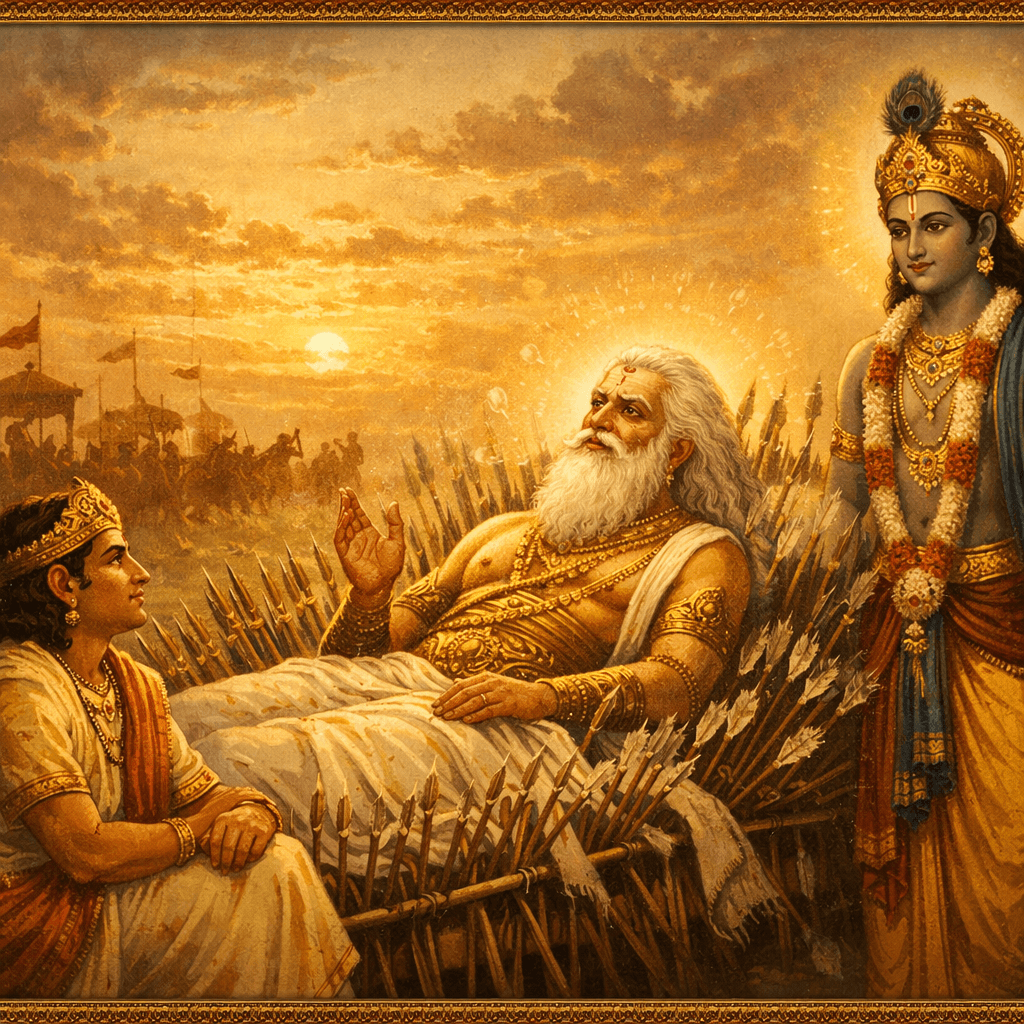
Bhishma had seized the young lady called Amba and denied her freedom of life. When Dushasana insulted Draupadi in the court session, Bhishma, due to the presence of acting emperor Duryodhana, kept silent, and so he deserved his sufferings and failures on the battlefield. Details about the past life of Karna are already available in the article Karma Siddhanta. For the resulting happiness or sorrows, one’s own past actions were the reasons. Hence, there was no need to feel sorry, and Bhishma consoled Yudhishtira.
What was the most famous recitation of Bhishma in this chapter?
Vishnu Sahasranama, or the thousand names of Vishnu in Sanskrit verses, was the most famous recitation. Under Anushasana Mahaparva, in Danadharma upa parva, this chapter of the Mahabharata was told by Bhishma to Yudhishtira before his Yoga Samadhi in Kurukshetra after the war.
These verses are also available in the Garuda Purana and in some other Puranas. In some editions, the counting of chapters may be different in sequence, but the main essence of these names is the same. God can have many names under the Sanatana Dharma. This Dharma is independent of time and permanent in this world, considering several aspects of the past, present and future. The main theme is devotion to God.
को धर्मः सर्व धर्माणां भवतः परमो मतः ।
किं जपन्मुच्यते जंतुर्जन्मसंसारबंधनात् ॥
“Which Dharma is the most reverend according to you? By chanting what, does the living soul get liberation from the bondage of the sorrowful cyclic role of birth and death?” Thus, Yudhishtira questioned Bhishma.
As the answer, Bhishma recited the feature-depicting thousand names of Vishnu. It is easy to get them by heart, as all the thousand names are available in a Sanskrit verse form. Some people by heart the names of Shiva, and some others desire the names of other deities in this world. Vishnu supports non-violence; hence, this chapter has become the most famous set of names of God, and is most popular in this world.
There is no restriction in reciting Vishnu Sahasranama. The esteemed readers are kindly requested to have a copy of a printed book on Vishnu Sahasranama for their daily use.
What were the other thousand names told by Bhishma to Yudhishtira?
Bhishma also told Yudhishtira about God Shiva, the Shivasahasranama.
What was the main reason behind the discussions of Yudhishtira and Bhishma for fifty-five days when Bhishma was practising Yoga after the war?
The main reason behind the discussions of Yudhishtira and Bhishma for fifty-five days, when Bhishma was practising Yoga after the war, was Yudhishtira’s desire for higher learning by sharing the knowledge from Bhishma. Yudhishtira could not undergo any higher learning or specialisation in the fields of administration lessons during his past life.
But Bhima had attended, with Duryodhana, his higher learning of mace fight under the tutelage of Balarama. Arjuna had attended his higher learning of Bharata Natyam under the tutelage of Urvashi. Sahadeva had attended, with Krishna, his higher learning of using sea shells under the tutelage of Narada. Sahadeva was using seashells for astrology, and Krishna was using Panchajanya, obtained from the sea. Nakula had attended, with Krishna, his higher learning of livestock welfare under the tutelage of Nandagopa. Nakula was looking after the horse herds, and Krishna worked as a charioteer to Arjuna.
But Yudhishtira could not get any such chances for higher learning during his past times. Hence, Yudhishtira made use of the fifty-five days of Bhishma’s Yoga to get higher knowledge in administration required for his future life as an emperor. Krishna advised this.
What was advised by Bhishma to Yudhishtira about satisfying the guest?
मातृ देवो भव । पितृ देवो भव । आचार्य देवो भव ॥
Bhishma advised Yudhishtira to treat mother as God. Then he advised Yudhishtira to treat father as God and next to treat teacher as God. Bhishma cautioned him to test the guest first and offer him any donation only if the guest was found trustworthy.
Bhishma told Yudhishtira the side story of Sudarshana. One day, Death had disguised himself and entered the house of Sudarshana in his absence and met his wife asking for her life. She told Death that she would give her life after the permission of her husband on his return. Death waited until the return of Sudarshana. But on returning to his own home, Death requested the lives of both husband and wife. They thought that unconditionally satisfying the guest was mandatory, so both of them lost their lives.
Thus Bhishma appreciated the three items – mother, father and teacher – to be treated with reverence; but with respect to any guest, he advised to test the guest and donate only if the guest was fully deserving.
Bhishma then told the side story of Bhrigu. He told how Bhrigu lost his wife, since she provided accommodation to the demon Tamasura in his absence, who visited as a guest. Bhishma said that like the three Vedas, only three items, mother, father and teacher, are to be specially honoured. He advised that providing donations should not be at the cost of the sufferings of any servants.
What did Bhishma tell for deserving a guest for the purpose of donating?
अतोऽन्यथा वर्तमानाः सर्वे नार्हंति सत्क्रियां । तस्मान्नित्यं परीक्षेत पुरुषान्प्रणिधाय वै ॥
For giving donations, persons acting in the wrong way never deserve to be accepted as guests. Therefore, such persons must be tested daily before being treated as guests. Donations given to deserving good persons only would be virtuous actions.
What was finally told by Bhishma to Yudhishtira in the Danadharma Parva?
ब्राह्मणाः सर्व लोकानां महांतो धर्मसेतवः ।
धनत्यागाभिरामास्च वाक्संयमतथास्च ये ॥
Bhishma later appreciated Brahmins. Brahmins who sacrifice money and speak with full control over their passions, that is, speak with truthfulness, are always reliable in this world. The Brahmin lifestyle was explained by Bhishma. Yudhishtira asked doubts about Dharma and its performance, connected with many relevant items. Several side stories were also told in support of inferences. Thus, fifty-five days passed, and Bhishma ordered them to arrange for his funeral on the next day, gathering various items for the rituals.
On the fifty-sixth day, Bhishma decided to end his life by doing Yoga Samadhi in front of Krishna. Yudhishtira, Dhritarashtra and a team of Brahmins well versed in reciting different branches of the Vedas were invited to Kurukshetra, the site of his Yoga Samadhi.
Yudhishtira asked, why should one worship Brahmins with high reverence?
When Yudhishtira asked Bhishma the above question, Bhishma replied that he was very tired, having spoken with him for the last fifty-five days without food but doing Yoga only. Bhishma desired to observe silence then, since the next day was proposed by him as his final day. Hence, he suggested that Krishna, as he was the expert, reply. Krishna was there, hearing them, and Yudhishtira allowed Bhishma to observe silence. Krishna tried to reply to Yudhishtira.
ब्राह्मणानेव सेवेत पवित्रं ह्येतदुत्तमं ।
ब्राह्मणान्सेवमानस्य रजः सर्वं प्रणश्यति ॥
The best and holiest Dharma was worshipping Brahmins. By serving Brahmins, all sins would vanish away. Thus, Krishna finally told in the Danadharma Parva. Krishna told them a side story about Durvasa, a powerful Brahmin but short-tempered.
A tall Rishi was found standing in the city junction and loudly asking who was interested in inviting him and treating him as a guest. The person should have patience and should not injure his feelings at any cost if invited. Nobody dared to speak with him. He was a slim Rishi but taller than the average, nearly seven feet. His hair was brown, but he appeared in good health. Krishna had great respect towards Brahmins, so he invited Durvasa to his palace.
In his palace, his wife Rukmini greeted him with high reverence. As usual, Krishna provided him with good accommodation and food for his satisfaction. Durvasa Rishi desired to have sweet and hot rice pudding on the following day, and it was prepared and offered to him by them.
The Rishi then told Rukmini to pour the sweet and hot pudding partly on the head of Krishna from the vessel. Krishna was standing on his right leg, playing a flute in his hands, to satisfy the Rishi, and his wife Rukmini was nearby. The hot rice pudding was smeared all over his body except under his right leg. Then Durvasa told Rukmini to pour the balance of the hot rice pudding over her own body and finish it completely. It was very hot, and both of them were fully smeared with the rice pudding.
Then the Rishi told them to bring a chariot, and when it was brought by Krishna, he told them to tie Rukmini and Krishna like the pulling horses of the chariot. Durvasa climbed on the chariot and ordered them to start pulling it on the city roads. When Rukmini could not pull due to fatigue, Durvasa started whipping them with a stick. Then he desired to return to the palace. People of the city were looking at the scenery with curiosity, but never commented on anything.
Then Durvasa desired to return and told them that, without asking, he would offer boons to Rukmini and Krishna as he was very much pleased by their hospitality and patience. Durvasa Rishi told Rukmini that she would never advance in age but always remain as a young lady with steady beauty in future. He told Krishna that nobody would be able to hurt his body wherever the rice pudding was smeared, and that he would always remain a healthy person with his son Pradyumna. His son Pradyumna was born later, and Krishna advised him to honour Brahmins in his palace.
Thereafter, the Rishi disappeared, and Krishna told this story to Pradyumna. All of them returned to Hastinavati to come again on the next day, Yudhishtira being satisfied. Bhishma was under Yoga Samadhi, but silently permitted them to go.
What did Janamejaya ask Vaishampayana about Krishna then?
Janamejaya asked Vaishampayana about Krishna – how Krishna got Yoga Samadhi on his final day. Vaishampayana explained that since the rice pudding was not smeared under his right leg, later a hunter could hurt him with an arrow on the final day of Krishna. It was also due to the curse of Durvasa Rishi. More about the curse of Durvasa is available on this website under the Mausala Parva.
Next post, Mahabharat: Bhishmarohana Parva would be more interesting.
Mahabharat: Ashwamedhika Parva would be presented separately in another article.
What are the benefits of reading this story?
On reading this story, children would gain more memory power, great moral strength in their lives in future; creating a sense of self-reliance, leading to peace and progress.
It is humbly prayed for the blessings of God Krishna upon us.
Readers may share this story with children, friends and family.
Leave a Reply