
Bhavishya Purana Khila is the hundredth Upa Parva included as the final Maha Parva. Vedavyasa Maharshi had taught all eighteen Maha Puranas to his disciples. Khila means appendix to the main Mahabharata pages.
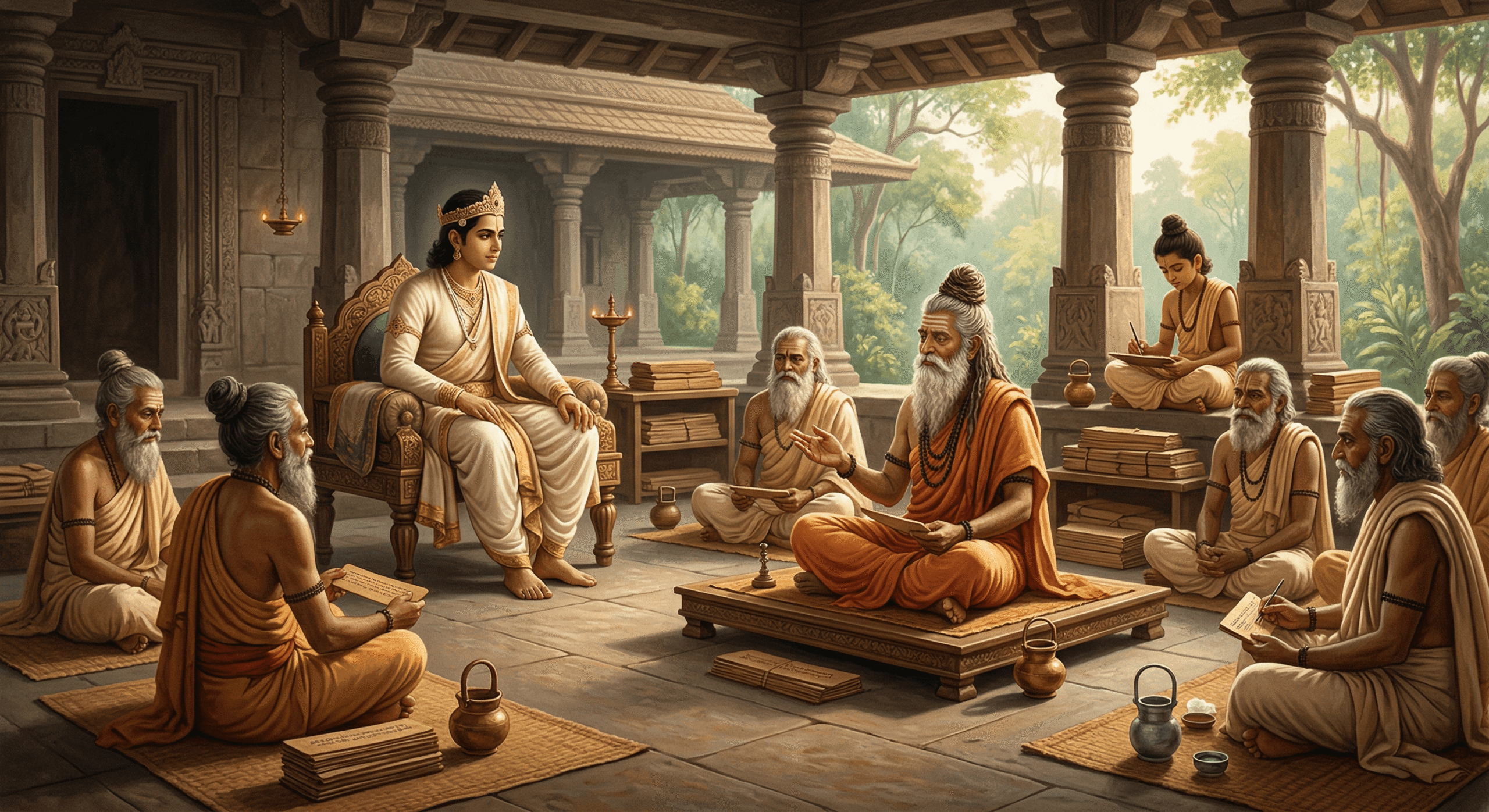
The assembly of the Rishi people in the court of King Shatanika desired to hear the Bhavishya Purana. Prince Shatanika was a young baby sitting on the lap of his father, Janamejaya, during the serpents’ yajna and heard the Mahabharata histories of his ancestors. Vyasa was alive since he was Chiranjeevi, but the generation had changed.
After assuming the charge of the empire, Shatanika had heard the Mahabharata once again, but at the end of conclusive days, desired to hear one more new Purana, since he was already reading the Bhagavata Purana frequently. Hence, this Purana was recited.
In the later editions, this had been edited since India had been ruled by many kings and subjected to their will and orders. Hence, the Bhavishya Purana had been suitably edited to please the ruling kings from time to time. The Jain kings had influenced Sanskrit literature during their regime, and hence the Khila Harivamsha Purana was already edited, as mentioned in the previous article on this website.
Later, the Buddhist kings, the Islamic rulers and the recent British rulers had influenced the Sanskrit literature, thereby trying to edit the Mahabharata or Puranas. The re-writers tried to satisfy the rulers, and hence the latest Bhavishya Purana had evolved in Sanskrit. Later, an optimised version of the Bhavishya Purana was compiled.
The main purpose of the publishers was to uphold the Sanatana Dharma Principles. Sanatana Dharma possessed an inherent property of sustainability in any situation elsewhere within India; the publishers were showing a soft approach to rulers in the literature compilation works.
Sumantu was a disciple of Vedavyasa Rishi and an expert in the Atharva Veda. But in the Amarakosha lexicon, the word Atharva Veda was barred, and only Arthashastra was permitted. It had two prominent branches, the first one being the Shaunakiya branch and the second one being the Pippaladaya branch (Pippaladaya).
Bhavishya Purana was not a Veda but a Purana, had the nature of stories, with recitation attributed to Shaunaka, disciple of Sumantu, under initiatives attributed to Vedavyasa Rishi. Tantra was highlighted more in it, but nothing against Agamas.
What happened to Yuyutsu finally?
Yuyutsu, after crowning Vajra, was relieved from administrative obligations and started his penance inside the Indraprastha Palace at his royal residence (room). After one hundred and twenty years of his age, by yoga Samadhi, he ended his life. Then Kripa was training Pareekshit, and Vajra was ruling in Indraprastha.
Whether the Mahabharata really happened in history or is a cooked story?
Mahabharata was a real history, and not a cooked story. The latitude of Vittal (Vittla) town is 12-47 North with longitude as 75-06 East, and the original hermit of Dhaumya is always available here.
A temple of Ishwara worshipped by the five Pandava brothers, with the name Panchalingeshwara, is available here as proof. The annual festival of the Vittal temple is proof of the real history of the Mahabharata. Several other proofs are available. The ancient name of this town was Ekachakri Nagar, and Dhaumya was mentioned on this website under the article Chaitraratha Parva.
Why is the Mahabharata honoured in this world?
The Mahabharata is honoured as the fifth Veda by many scholars. In the Mahabharata, the histories of the Kauravas and Pandavas were described by Vyasa, but Dharma was emphasised more, keeping non-violence as the inherent, better political feature.
What was the importance of the word and the meaning of ‘Bhavishya’?
The meaning of the Sanskrit word ‘Bhavishya’ is ‘future’. Vyasa had compiled it as an important text for future reference. A few verses in Sanskrit were collected by some scholars, but most of them would be available in the Bhagavatha Purana also. Hence, it could be consulted by the esteemed readers.
How was the Bhavishya Purana published?
Bhavishya Purana was edited and published in Sanskrit during the British regime. Some University professors were granted financial assistance as scholarships, and they carefully tried to keep the Western type of predominance in the verses and tried to publish a pleasing book.
Later, the scholars within India and outside India engaged in debate about various contents of this book, now and then, and the latest volumes evolved. Hence, the ideologies of the latest religions of the world also penetrated into this book.
Time is a precious item. Some people are still present in India, with the ability to recite one of the branches of the Vedas orally, if financial and overall security for their life is assured. It is better to get some opinions from such persons rather than to read the available volumes of textbooks on the Bhavishya Purana.
Astrological verses, items on Palmistry, and codes on cultural rituals were also seen in it. ‘Guru’ means a teacher knowing about Sanskrit. It is also further recommended to consult such a living ‘Guru’ type Vedic scholastic people, say a Vedic teacher, if necessary.
Who was Samba, and who was his teacher?
Samba was the youngest son of Krishna. Jambavati was his mother, and his few details were described in the Harivamshapurana of this website. His primary education was provided by Krishna in the Dwaraka Palace. But there was no teacher to provide him with higher education in Dwaraka, and his father directed him to approach Durvasa Rishi for it. Samba approached teacher Durvasa.
Why did Samba construct the Konark Surya temple?
Samba had constructed the Konark Surya temple, feeling thankful to the Sun God for giving him good health. Samba was a student under Durvasa at his hermit. He was assigned the task of procuring water in the early morning for the prayers of Durvasa. Samba was prompt in bringing water in a pot every day after morning bath, early in the fixed time for Durvasa as prescribed by him.
One day, in the winter season, Samba could not rise before sunrise and was a little bit delayed in bringing the water pot. On all other days, he was passing through the flower garden in the early morning, and hence nobody was noticing his movements. Durvasa had disliked his delay.
After the Mahabharata war, Samba had been crowned for the vacant throne of some kingdoms taken together for the east coast of the Indian sub-continent. Symptoms of skin diseases were felt by him, and he ultimately consulted Durvasa, being his teacher, but education was over. Durvasa advised worshipping the Sun God, and he had done the same. He recovered fully. Samba had constructed many temples for the Sun God. Some of them are still present in good condition.
Next post, Annaprashana and Vidyarambha would be more interesting.
‘Indian Vegetarian Food Systems’ would be presented separately in another article.
What are the benefits of reading this story?
On reading this story, children would gain more memory power, great moral strength in their lives in future; creating a sense of self-reliance, leading to peace and progress.
It is humbly prayed for the blessings of God Krishna upon us.
Readers may share this story with children, friends and family.
Leave a Reply