
According to the Indian tradition of the Sanatana Dharma, the human life system is not God-centric, but it is human-culture-centric. A Sanatana Dharma follower or any family member may believe in any particular God or not (being optional), but has to observe four principles.
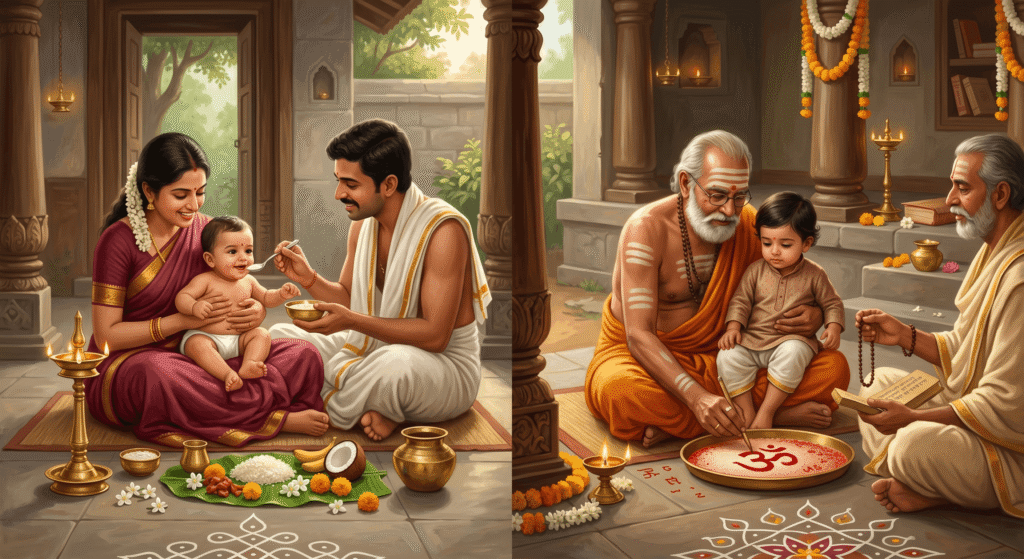
Truth is the first principle, and an article on this principle has already been published on this website. After six months, a child should be given solid foods, and it is called Annaprashana karma, or the baby feeding ceremony. Some Sanskrit verses are used during the baby feeding ritual. In case a father or a mother is unable to accomplish it, then somebody in that society would be doing it. Hunger and food are unavoidable parts of the truth.
Later, kindness is the second principle. Kindness is natural for elders towards children. After three years, a child should be taught about cleanliness and how to speak. Then the child would be very particular about neatness, washing with water and taking a bath. Daily bathing is practised by the Indians from early childhood.
Similarly, living in neat and clean premises is also taught to the child. The importance of Suchitva, or cleanliness, is the third principle in the Sanatana Dharma. When the child starts to speak, then it is administered into letter writing and this ritual is called Vidyarambha karma. During the evening, around the time of sunset, the child would be doing short duration of prayers with actions in their house. Evening or morning, name chanting, called as Japa, is taught by parents, followed by the bath daily.
Donation is the fourth principle of Sanatana Dharma. Donation should be decided by the donor. The doubts of the child are cleared in the bedtime stories after night food, before sleeping. In a peaceful society, these four principles later lead the child to be a good and responsible citizen serving their own nation or the global system of the world. So the basic human culture starts with Annaprashana and proceeds through Vidyarambha.
Some people conduct the Annaprashana ceremony of their child in some temples. The temple authorities prescribe a list of stores for it with a small fee or donation. Then a day would be decided, and the parents would be busy preparing for this timely occasion with the child. The temple personnel, after the daily worship, arrange for the baby’s feeding. The baby’s feeding starts with soft, tasty foods that are purely vegetarian. Some people do the baby feeding in their own residence, with simple rituals, without publicity.
Similar to it, some people conduct the Vidyarambha ceremony of their child in some temples. The temple authorities prescribe the time and a list of stores for it. On that decided date and time, the parents get busy preparing for the occasion with the child. The temple authorised persons, after or before the daily worship, arrange for the baby to be administered the letter writing. The baby’s learning starts with easy letters, and later, Indian vegetarian food is served. An article on Indian vegetarian food systems will be available on this website.
The Sanskrit language plays an important role in the above two items. The importance of the influence of Sanskrit verses is to a great extent in the life of all in India, and hence, people try to hold these two events in the proximity of such verses. The timely rituals are codified in the referred Sanskrit Verses. These are called as Prayoga Mantras. Prayoga means experimenting. Mantras mean Sanskrit Verses.
The ‘Learned Person’ learns the required Sanskrit verses by heart as per the need of the hour. He has practised the learning of verses for many years, dealing with the Vedic hymns, and only after permission from his teacher, he starts the service or experimenting. Sometimes, there are two or more persons engaged as a team during the reciting of the Vedic Sanskrit Verses. Referring to a printed book is not mandatory. A single person reciting Vedic verses without the help of a second person’s presence is also possible during such Indian style rituals.
After the above two ceremonies, the child continues to grow up and get a good education. Later in society, they accept a job and try to earn money for life.
अयं निजः परोवेति गणना लघुचेतसां ।
उदार चरितानां तु वसुधैव कुटुंबकं ॥
Meaning: “He is my person, the other one belongs to the other group;” – such considerations are done by narrow-minded (light-hearted) people only. For the broad-minded people, the entire world is like a single family, and all are treated as its members.
This is the result of the provision of the basic cultural background to the children
What are the benefits of this article?
Annaprashana and Vidyarambha are articles related to Sanatana Dharma as well as under the purview of Karma Siddhanta principles, published on this website. There are two more Sanskrit words, better known, related to these items. These are Karya and Karana. Karya means serious work, Karana means reasons. By observing Annaprashana, human beings would not face any serious obstacles in their life in the path towards achieving success and good health of the child in future.
Also, by observing the rituals of Vidyarambha, human beings would not feel any disappointments in the middle of their life on the path proceeding towards success in procuring a better job in future. Prosperity is the result.
Vishnu Sahasranama Japa, which means chanting the thousand names of Vishnu, is also a virtuous work in a human’s life, equivalent to worshipping any desired deity. Devotion to God is considered a good character of human beings, but not compulsory. The child easily learns poems they’re interested in and gets them by heart. Readers would get a successful family life. Let us pray, the holy Gods, always shower blessings on us.
Next post, ‘Indian Vegetarian Food Systems’ would be more interesting.
‘Indian Dress Codes’ would be presented separately in another article.
On reading this, children would gain more memory power, great moral strength in their lives in future; creating a sense of self-reliance, leading to peace and progress.
It is humbly prayed for the blessings of God Krishna upon us.
Readers may share this story with children, friends and family.
Leave a Reply